
THE SHAIYAA KNOWLEDGE BASE · WINTER & GIFTING
What is a Jaipuri Rajai? A Jaipuri Rajai is a filled bedding cover associated with Jaipur’s textile tradition. The name alone does not confirm cotton content, filling weight, handwork or a tested warmth level. To understand a particular rajai, read its outer-fabric and filling specifications, finished measurements, stitching and cleaning instructions. Those details explain what you are choosing far more reliably than the regional name.
In this guide
- What makes a Jaipuri Rajai different?
- Understanding the outer fabric and filling
- Why consider lighter-feeling winter bedding?
- Jaipuri Rajai vs a heavy blanket: what should you compare?
- How to choose single or double coverage
- How much filling should you choose?
- How to choose a print without overwhelming the bedroom
- How should you layer a rajai?
- How do you care for a cotton-filled rajai?
- What should you check when it arrives?
- A clear shortlist is better than a quick guess
A good winter cover should be easy to understand. You should know what touches your skin, what sits inside it, how much bed it covers and how to look after it. Yet rajai descriptions often mix emotional language with incomplete information. “Traditional,” “premium” and “lightweight” can sound reassuring while leaving those practical questions unanswered.
This guide takes one documented Shaiyaa rajai as a worked example, then explains how to use the same questions anywhere you shop. It does not rank all Jaipuri bedding, certify provenance across a whole category or claim a universal winter temperature range. The aim is to make you a more confident reader of a product description.
What makes a Jaipuri Rajai different?
Start by separating identity from specification. “Jaipuri” tells you the style or regional association being claimed. “Rajai” tells you that you are looking at a filled bedding cover. Neither word, by itself, establishes who made it, how the print was applied or what the filling contains. Those are separate facts, and a transparent listing should identify them individually.
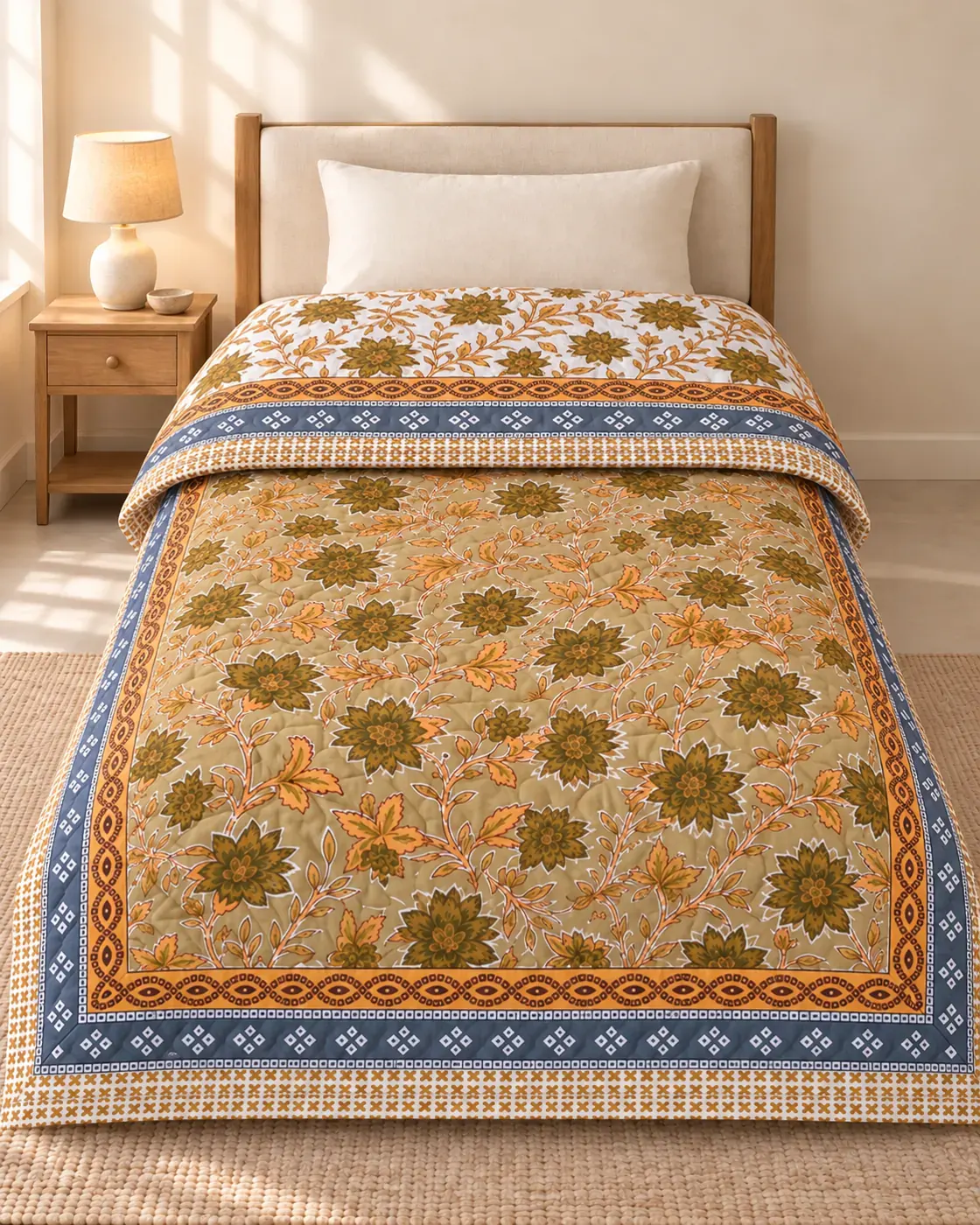
The Shaiyaa Mulmul Single Rajai specifies a 100% mulmul cotton outer, 650 g of pure cotton filling, hand quilting, piping and bag packing. Its listed size is 60 × 90 inches and approximate total weight is 1.1 kg. This is useful information because you can distinguish fabric, filling, finish, size and presentation without guessing.
That one example does not prove that every Jaipuri rajai has the same construction. Another range may use a different fabric, more filling, different stitching or a smaller finished size. If a seller describes the print as hand-block printed, ask whether that claim applies to the exact design shown. Do not infer a printing technique from a motif that simply looks traditional.
Understanding the outer fabric and filling
The outer fabric forms the two visible faces of the cover. Mulmul, also written malmal, is the cotton fabric named in this example. The filling is the material held between those faces. A listing that says “cotton rajai” should clarify whether cotton refers to the exterior, the filling or both. This is especially important when comparing products with very different descriptions.
A soft face fabric cannot tell you what is hidden inside. Conversely, a clearly stated cotton filling does not describe the stitching or care method. Read the whole specification before forming an impression. If the filling is described only as fibre, ask for the fibre composition. If no filling quantity is supplied, record that as an unknown instead of estimating it from the photograph.
People sometimes compare the 650 g fill figure with the total weight of another item. That is an uneven comparison. The 650 g refers only to this rajai’s filling, while 1.1 kg refers to the complete piece. Outer fabric and finishing contribute to the total. Always compare filling with filling, or total product weight with total product weight, for similarly sized items.
Why consider lighter-feeling winter bedding?
Some people want a cover that is easier to lift, fold and adjust. Others enjoy a substantial feel. Neither preference determines quality on its own. If you find your present blanket cumbersome, explain the specific difficulty: does it feel restrictive, slide off, take up too much cupboard space, or become awkward when you make the bed? Each issue suggests a different comparison.
Ask for the total weight and dimensions together. A large double cover will naturally require more handling than a smaller single piece, even if its fabric feels light. Compare like sizes before deciding one range is lighter. A photograph of a loosely folded rajai can suggest drape, but it cannot establish how the item will feel around you during a full night.
Lightness should not be used as a promise of extraordinary insulation. Without a product-specific test, there is no basis for saying a given weight will suit every cold room. A sensible approach is to choose the construction and handling you prefer, then keep your bed adjustable. You can add or remove an appropriate layer as your own comfort requires.
Jaipuri Rajai vs a heavy blanket: what should you compare?
A blanket and a rajai can differ in structure, but blanket is also a broad category. It may describe a woven textile, a fleece layer or another construction. Before comparing, write down what the blanket actually is. Otherwise “rajai versus blanket” becomes a comparison between one documented product and an undefined idea of heaviness.
| Decision point | For a rajai | For a blanket |
|---|---|---|
| Construction | Identify outer fabric, filling and stitching | Identify fibre and whether woven, knitted or another construction |
| Handling | Compare total weight and size | Compare total weight and size |
| Warmth | Ask about intended use; do not invent a rating | Ask about intended use; do not rely only on thickness |
| Care | Confirm permission to wash the filled item | Follow the exact fibre and finish instructions |
| Best choice | The piece whose coverage, feel, care and documented construction suit your home | |
If the blanket you already own works well, there is no need to replace it because another category sounds more refined. Consider a rajai when it solves a real issue or gives you a useful alternative. The dohar, quilt and rajai comparison explains how these overlapping terms fit together without turning them into a fixed warmth ladder.
How to choose single or double coverage
Start with your sleeping arrangement rather than the mattress label. One adult on a double bed may prefer a single cover. Two adults on the same bed may prefer separate covers. A shared double cover may look simpler when the bed is made but become frustrating if one person turns frequently or wants a different amount of coverage.
Measure the mattress and compare the finished cover dimensions. A 60 × 90 inch single rajai centred on a 36 × 72 inch mattress has 12 inches of flat excess width on each side and 18 inches of extra length overall. Those are layout measurements, not sleeping-fit guarantees. Bodies, movement, mattress depth and where you position the cover change the useful coverage.
For a double option, ask for the actual measurements of the current range instead of doubling a single specification. Do not assume every product called double has identical dimensions. The Shaiyaa Size Guide provides a visual starting point. For a gift, a discreet measurement or a question to the household can prevent a beautiful cover arriving in an impractical size.
How much filling should you choose?
More filling is a specification, not an automatic recommendation. The useful question is whether a product’s complete construction suits the person and room. Ask about filling quantity, distribution, stitching and total weight. Do not turn a gram figure into a claim about weather performance unless the manufacturer provides a valid, relevant test for that exact product.
For example, the adult Mulmul Single Rajai lists 650 g cotton filling, while Mama Kids Rajai lists 750 g with different finished dimensions. It would be misleading to rank their suitability by those figures alone. They are separate products, and the child’s intended use requires separate consideration. A number becomes useful only when you understand what it measures.
How to choose a print without overwhelming the bedroom
Look at the largest fixed surfaces first: walls, curtains, headboard and floor. Then decide whether the rajai should be the main pattern or a quieter companion. If the room already contains strong prints, compare a smaller motif or more restrained colour combination. If the room is simple, a more expressive top layer may be the detail that gives it character.
Use a full spread photograph to understand pattern scale and a close-up to inspect colour and stitching. A tiny phone thumbnail can hide a large border or make a small repeat look like texture. Ask which photographed design is available, and save that exact image with your order. A collection name can contain several prints; it is not a unique design reference.
You do not need to purchase matching pieces for every visible surface. A plain or quieter sheet can let a printed rajai stand on its own. Our slow-living bedroom guide explores a calmer approach to arranging the room. Think of styling as making the space easier to enjoy, not filling every gap with another accessory.
How should you layer a rajai?
For an adult bed, begin with the sheet and whichever cover already works for most of the night. Keep the rajai available as the additional layer. You may use it across the whole bed, over one person’s side or only when conditions change. There is no obligation to maintain the same combination from bedtime until morning.
If combining it with a dohar, compare their finished sizes and test how they move together. A small top layer can shift away from a wider base, while tight tucking can make adjustment inconvenient. The winter bed layering guide explains how to build a flexible arrangement without automatically making the bed heavier. Infant sleep arrangements should follow separate authoritative guidance.
How do you care for a cotton-filled rajai?
Ask for the exact care instructions before the first clean. Cotton fabric outside does not mean the complete filled item can be machine washed. The filling, stitching and finish all matter. Do not borrow washing permission from a dohar or bedsheet simply because both products use cotton. A general care article is a supporting resource, not a replacement for the item’s label.
Plan where the rajai can dry if washing is permitted. A piece that feels dry on its surface may still need more time through its filled sections. Follow the supplied drying method and avoid packing it away while damp. If professional cleaning is required, consider whether that fits your routine and local access before you buy rather than discovering the limitation after a spill.
Between seasons, check that the piece is clean and fully dry, then fold it without forcing it into an unnecessarily tight space. The supplied bag may help keep the set together, but a packing bag is not permission to seal damp bedding. Consult the Care Guide and the washing article for the general sequence of checking, cleaning, drying and storing.
What should you check when it arrives?
Open the parcel carefully and compare the contents with the order confirmation. Check the selected print, listed dimensions, included pieces and visible finish. Look along the edges for the piping and across the surface for the stated quilting. Keep packaging until you have reviewed the product and the current return conditions. Photographs taken at receipt can help explain any discrepancy clearly.
Read the care label before deciding on a first wash. If the label and product page appear inconsistent, ask for clarification instead of choosing the more convenient instruction. An informed purchase includes the ability to maintain the textile afterwards. Keeping the product name and original specifications with your household records makes future care questions easier to resolve.
A clear shortlist is better than a quick guess
Reduce the decision to three candidates at most. For each, record final size, outer material, filling, total weight, care and the exact print you like. Put a question mark wherever the description is incomplete. This small comparison often reveals that one item simply fits your daily life better, even before price or styling becomes the deciding factor.
Explore the current Jaipuri Rajai range only after identifying what you need from the layer. For a child, continue with the children’s bedding guide; for someone else’s home, use the gifting guide. A good choice is one whose construction and limitations you understand, whether you buy now, choose another type of cover or keep using what already works.
A 60 × 90 inch mulmul cotton rajai with 650 g pure cotton filling. Double-bed malmal rajai with pure cotton filling, Procian print and hand piping. Ready size after quilting: 91 × 103 inches.Explore from Shaiyaa
Mulmul Single Rajai – 650 g Cotton Filling
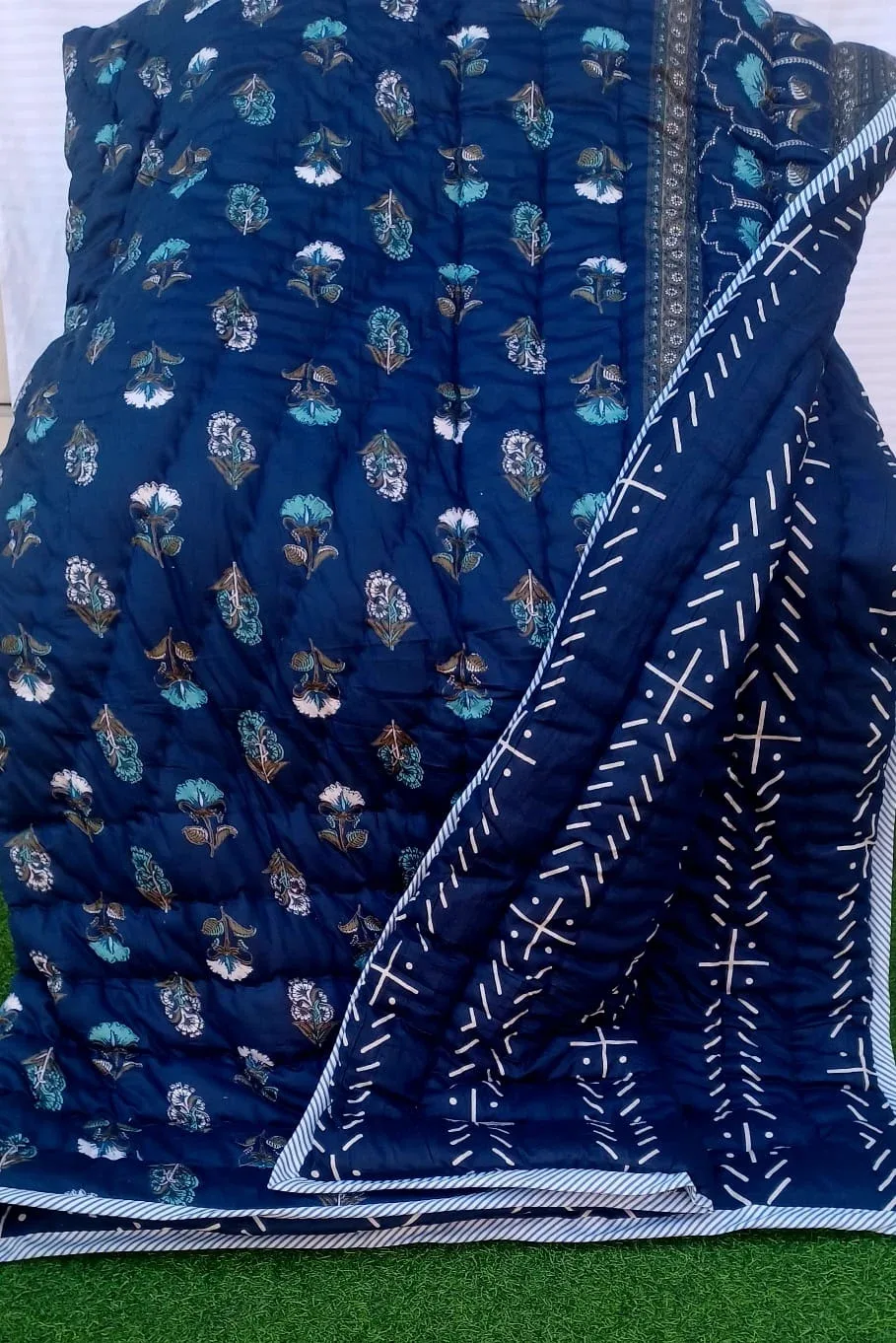
Rajwada Double Rajai
Still have a product question? Ask Shaiyaa on WhatsApp.
Published by Shaiyaa. Product examples checked against the current Shaiyaa listings for this revision. Follow the exact item’s supplied instructions.
WINTER BEDDING GUIDE
Compare the layer, not just the label.
Rajai, dohar and quilt names can overlap. Compare the actual outer fabric, filling, finished dimensions, stitching and care before deciding what suits your winter routine.