
THE SHAIYAA KNOWLEDGE BASE · WINTER & GIFTING
Quick answer: choose children’s winter bedding by the child’s age, the intended use, finished dimensions, documented fabric and filling, and care requirements. A dohar, quilt or rajai name does not establish suitability on its own. For an older child, compare lighter and filled covers against the actual bedroom and preferences. Infant sleep is a separate safety question; an “infant” catalogue label is not a sleep-safety approval.
In this guide
- Start with age and intended use
- What is the difference between a kids dohar, quilt and rajai?
- Understanding the Infant Dohar listing
- Understanding Tiny Kids Dohar
- Understanding the two kids rajai examples
- Compare the actual Shaiyaa measurements
- How should you assess size for an older child’s bed?
- What should you check about fabric and feel?
- How do naps, visits and travel change the questions?
- Care requirements deserve a place on the shortlist
- A six-question checklist for parents
- Choose a role before choosing a print
Children’s bedding can be particularly confusing because a playful print, an age-range description and a bed-size label may all appear on the same page. None tells the complete story. A long single-bed dohar may sit within a children’s collection, while a smaller textile may be named Infant Dohar. The practical task is to understand the item before deciding what role it should have.
This is a product-selection guide. It explains dimensions, materials, care and the questions worth asking. It does not prescribe sleeping temperatures, diagnose comfort problems or certify products for infant sleep. Where age-appropriate sleep safety affects the decision, use authoritative guidance and your child’s healthcare professional rather than taking a retail description as the answer.
Start with age and intended use
Write down what the bedding is for before opening a product collection. Is it for an older child’s regular bed, an additional cover during supervised awake use, a visit to grandparents or a gift whose use the parents will decide? These situations are not interchangeable. A product that can be carried easily is not automatically appropriate for every sleeping arrangement.
For babies under 12 months, the NHS advises against duvets and pillows for sleep; the Lullaby Trust also advises against soft or bulky bedding such as quilts. Consult the NHS baby bedding guidance and the Lullaby Trust bedding guidance before choosing sleep equipment. This article does not turn a dohar into an approved alternative. Ask about the exact product and its intended use, and keep the family’s age-appropriate sleep arrangements separate from shopping categories.
For an older child, describe the room and current bedding in everyday terms. Does the present cover feel too cumbersome? Is it too short? Is frequent washing essential? Does the child prefer a familiar light textile? Start with those observations. Buying a thicker product simply because the calendar says winter may overlook the practical issue you actually need to solve.
What is the difference between a kids dohar, quilt and rajai?
A dohar is generally a layered cover. A quilt typically has fabric and filling held together by stitching. Rajai is a familiar name for a filled bedding layer, often considered for winter. These categories overlap, and children’s ranges do not make the terms more precise. Read the material and construction of the particular item rather than building a warmth ranking from its name.
If a dohar listing names only the outer fabric, do not assume the composition of the middle. If a rajai lists total weight, do not treat it as filling weight. If a quilt is photographed across a cot, do not take the styling as evidence of age suitability. The main bedding comparison explains these terminology and specification differences in more depth.
| Question | Kids dohar | Kids quilt or rajai |
|---|---|---|
| What construction should I check? | Outer fabric and every stated layer | Outer fabric, filling and stitching |
| Does the name establish warmth? | No; compare the actual item | No; filling and complete construction differ |
| Which measurement matters? | Finished width and length | Finished width and length |
| Can it be washed at home? | Only where the exact instructions allow | Only where the exact instructions allow |
| Does “kids” establish safe use? | No; age and use need separate consideration | No; age and use need separate consideration |
Understanding the Infant Dohar listing
Shaiyaa’s Infant Dohar is listed as a reversible cotton dohar measuring 48 × 58 inches, approximately 450 g, supplied in chain bag packing. Those are the product facts. The name describes a range; it does not establish an infant-sleep recommendation. The live product page itself distinguishes the catalogue age range from safe-use guidance.
When reviewing a smaller textile, compare its finished measurements with the intended activity and ask the seller to clarify instructions. Do not assume it is suitable as extra mattress padding, a cot liner or a sleep-positioning product. Those are different uses that cannot be inferred from the word dohar. A decorative photograph does not override the written instructions or authoritative sleep guidance.
For a gift, ask the parents whether this kind of item is wanted and how they intend to use it. You can share the actual dimensions and material without telling them where it must go. Giving parents that choice is more useful than attaching a broad claim such as perfect for every newborn. Small format and attractive packing should remain product characteristics, not safety claims.
Understanding Tiny Kids Dohar
The Tiny Kids Dohar lists malmal cotton, hand piping, a 57 × 87 inch final size and approximately 800 g total weight. It includes one single-bed dohar. That is considerably larger than the 48 × 58 inch Infant Dohar. Compare the actual numbers instead of assuming tiny means the smallest item in the collection.
A larger dohar may be relevant to an older child’s single bed, but measurement is only the first check. Confirm the intended use and care, then compare the child’s existing cover. If that cover has useful dimensions, measure it directly. Describing what already works gives a better reference than buying by an age estimate or guessing how much excess fabric is desirable.
Hand piping describes the listed edge finish. It does not establish the composition of an unstated middle layer or provide a tested warmth rating. Keep those claims separate when comparing. An honest specification can leave something unknown; the right response is a question to the seller, not a confident assumption that all dohars use the same three-layer construction.
Understanding the two kids rajai examples
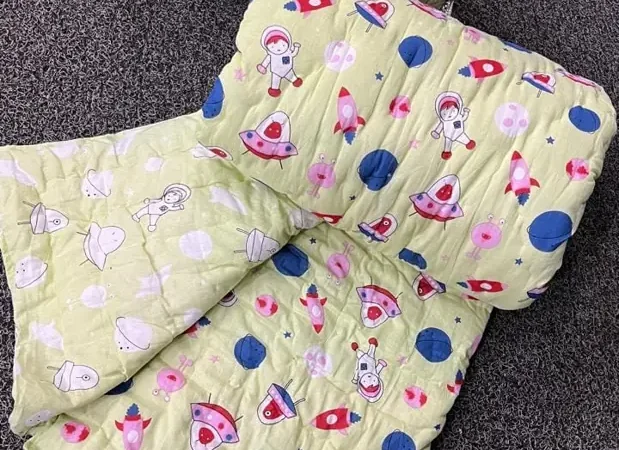
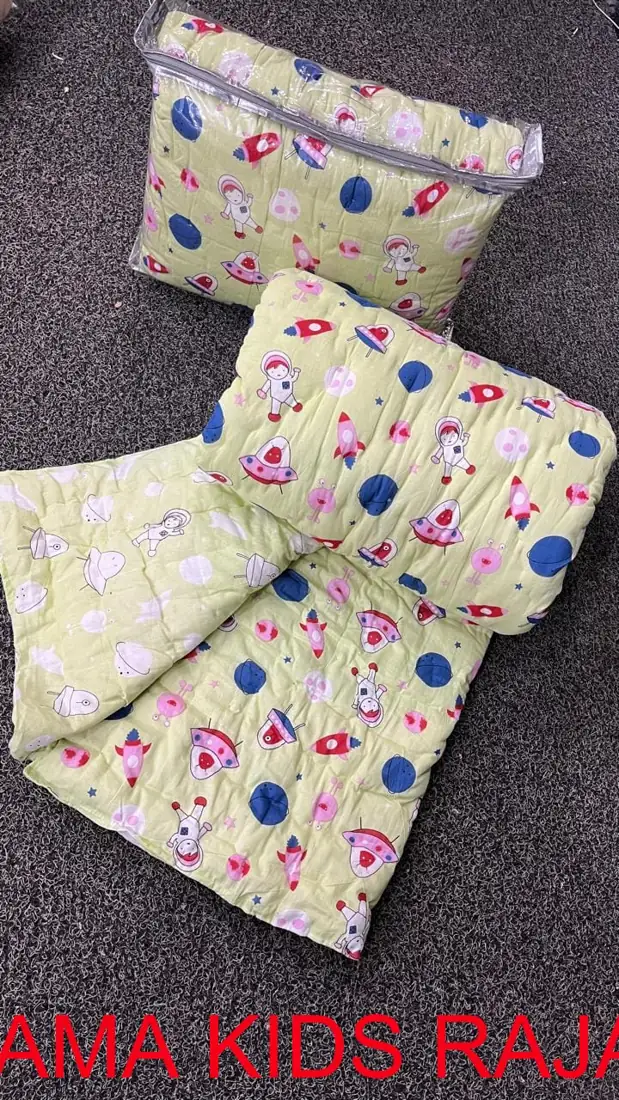
Mama Kids Rajai specifies a 100% cotton voile or mulmul outer and 750 g pure cotton filling. The ready size is 56 × 86 inches, with an approximate total weight of 1.25 kg. Its nominal size is 60 × 90 inches. Use the smaller ready measurements when assessing actual coverage rather than relying on the larger nominal label.
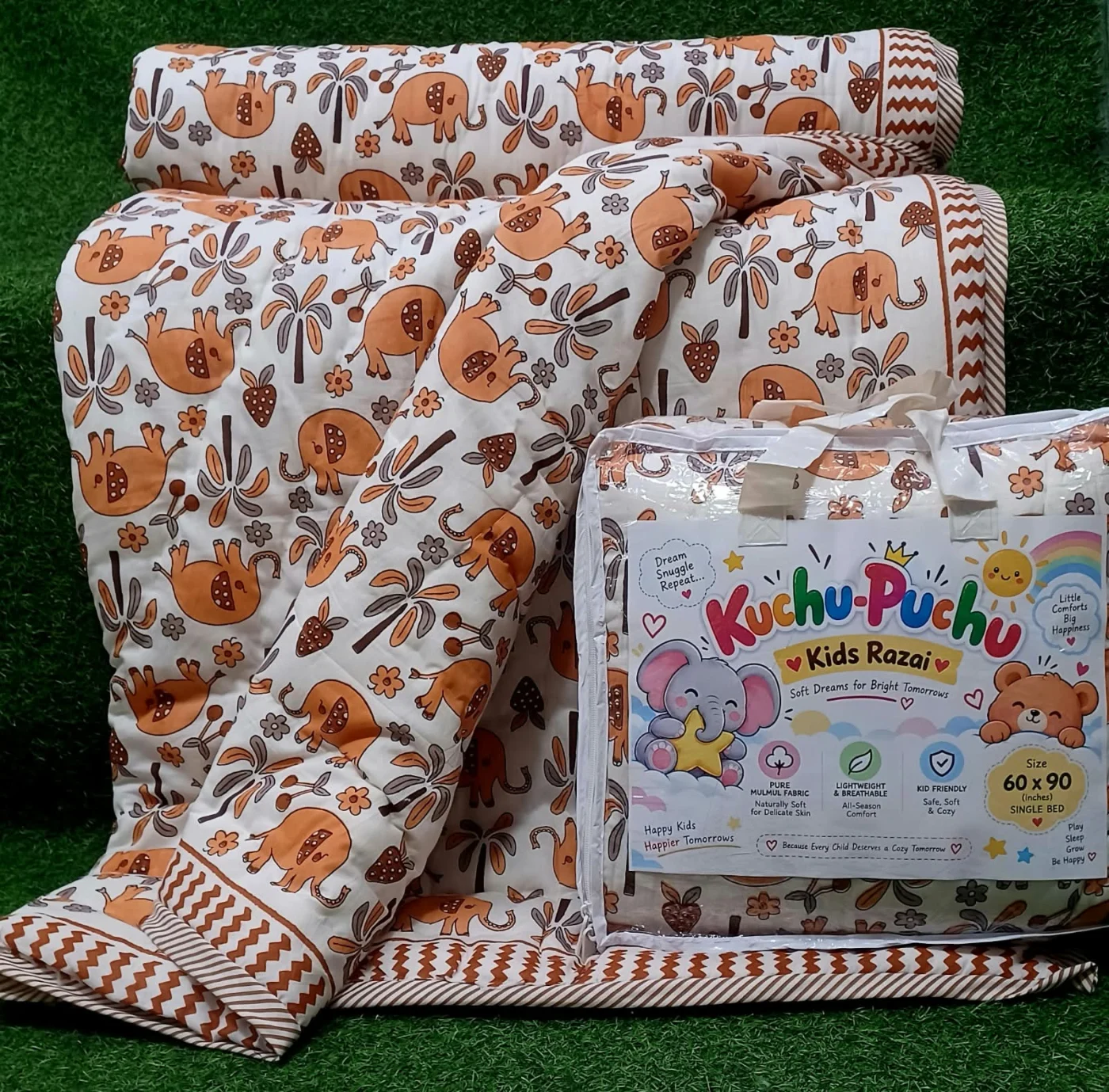
Kuchu Puchu Jaipuri Rajai lists a 100% malmal cotton outer, pure cotton filling and hand magzi stitching. Its final size is 55 × 85 inches and approximate total weight is 1.1 kg. A filling quantity is not specified in that listing. Do not infer it by subtracting an estimated fabric weight from the total.
These examples show why a product table is useful. The two rajais have similar but different dimensions, different stated weights and different levels of filling detail. None of those facts alone answers which is appropriate for a particular child. Compare the intended use, handling, instructions and family’s existing bedding before making that decision.
Compare the actual Shaiyaa measurements
| Product | Final or ready size | Approximate total weight | Documented construction |
|---|---|---|---|
| Infant Dohar | 48 × 58 inches | 450 g | Cotton; reversible |
| Tiny Kids Dohar | 57 × 87 inches | 800 g | Malmal cotton; hand piping |
| Mama Kids Rajai | 56 × 86 inches | 1.25 kg | Cotton voile/mulmul outer; 750 g cotton filling |
| Kuchu Puchu Rajai | 55 × 85 inches | 1.1 kg | Malmal cotton outer; cotton filling; hand magzi stitching |
This is a specification comparison, not an age chart or an endorsement of infant sleep use. Product details can change, so recheck the linked listing before ordering. The weights refer to complete items except where filling is explicitly named. The table deliberately does not assign temperature ranges or ages that the specifications cannot establish.
How should you assess size for an older child’s bed?
Measure mattress width, length and depth, then measure a cover the child already uses comfortably. Keep sleeping coverage separate from decorative drape. A large textile spread across an empty mattress can look generous but behave differently once someone is underneath. Equally, more excess fabric is not automatically a better fit. Describe the intended arrangement clearly when asking for guidance.
Use the Size Guide to understand flat coverage, then compare the product’s final measurements. Do not buy a much larger cover only on the assumption that the child will grow into it. Future use is worth considering, but the present arrangement and instructions matter first. A useful purchase should have a clear role now rather than depend entirely on a later possibility.
What should you check about fabric and feel?
Read the outer fabric, filling and finish as separate entries. Cotton describes a fibre; quilting and piping describe construction or finish. Reversible describes the ability to use the two sides as presented. None is a substitute for the others. Ask for a close-up photograph if you need to inspect the print or stitching, and ask which exact design is currently available.
For an older child who can express a preference, show a small shortlist of suitable options after you have checked the practical details. Let them choose between prints rather than asking them to evaluate care or filling claims. A familiar colour or motif can make the piece feel personal without turning the choice into a promise about better sleep, health or development.
How do naps, visits and travel change the questions?
A cover used at grandparents’ home needs instructions that another adult can understand. A textile taken on trips needs a suitable carrying and cleaning plan. A spare intended for occasional use needs somewhere clean and dry to live. These are practical differences, but they do not remove the requirement to check age-appropriate use and the conditions of the actual sleep space.
A supplied bag helps with organisation, yet the bag does not tell you whether the textile is ready for immediate storage after use. Make sure the piece is clean and completely dry before packing it away. Keep its name and care instructions together so the next caregiver does not assume it can be washed like another cotton item in the household.
Care requirements deserve a place on the shortlist
Ask how the complete item should be cleaned, not just whether cotton is washable. Filling, printing, stitching and trims can affect the instructions. If frequent laundering is essential to your routine, establish that before ordering. Do not discover after the first spill that a filled piece requires a cleaning method you cannot manage conveniently.
Read the washing guide and Care Guide for general habits, then follow the exact product label. Ask how to dry and store the item as well as how to wash it. For gifts, include those instructions in a form the parents can keep; a useful gift should not arrive with an unexplained care burden.
A six-question checklist for parents
- What is the child’s age and the exact intended use?
- What are the final dimensions, rather than the nominal range label?
- Which materials are documented for the outer fabric and any filling?
- Is the stated weight for filling or the complete product?
- What washing, drying and storage instructions apply to this item?
- Which photographed design is available, and what pieces are included?
Send those questions in one message, alongside the dimensions of a cover that already works for your household. This turns “Which one is best for my child?” into a more useful conversation. If a specification is not available, keep it marked as unknown. Neither a seller nor a guide should fill the gap with an invented assurance.
Choose a role before choosing a print
The Shaiyaa Little collection is a place to compare products, not a substitute for deciding how they will be used. Start with age-appropriate needs, identify the dimensions and care you can manage, then choose a design. For older children’s bedding, a familiar lighter cover and an appropriate separate option may be worth discussing rather than assuming one product must do everything.
The Rajai guide explains filling and total weight, while the gifting guide offers a thoughtful way to involve parents in a present. The useful outcome is clarity: knowing what the textile is, what the listing does and does not establish, and which questions still need an answer before it comes home.
A 55 × 85 inch malmal cotton rajai with cotton filling and hand magzi stitching.Explore from Shaiyaa
Kuchu Puchu – Jaipuri Rajai
Still have a product question? Ask Shaiyaa on WhatsApp.
Published by Shaiyaa. Product examples checked against the current Shaiyaa listings for this revision. Follow the exact item’s supplied instructions.
WINTER BEDDING GUIDE
Compare the layer, not just the label.
Rajai, dohar and quilt names can overlap. Compare the actual outer fabric, filling, finished dimensions, stitching and care before deciding what suits your winter routine.