
THE SHAIYAA KNOWLEDGE BASE · BEDDING SLEEP
Quick answer: start with a light dohar if you want a gentle cover, consider a quilt when you need a stitched filled layer, and compare an AC comforter by its actual shell and filling. A cotton-filled Jaipuri razai can provide a warmer option. The right choice depends on your room, how warm you sleep and the product’s construction—not its name alone.
In this guide
- What is a dohar, and why does construction matter?
- What makes a quilt different?
- What does “AC comforter” actually mean?
- Where does a cotton-filled Jaipuri razai fit?
- Dohar, quilt, comforter and razai at a glance
- Breathability is about the whole bedding system
- Use room temperature as a starting observation
- Three bedrooms, three different decisions
- What if two people sleep at different temperatures?
- Choose the finished dimensions, not the bed-size name
- Cleaning can decide which layer is practical
- Build a small, flexible bedding wardrobe
- Questions worth sending before you order
- A five-night comfort check before your next purchase
- Frequently asked questions
You switch off the light, pull up the new cover and, twenty minutes later, push half of it onto the floor. The bedding looked lovely online. It simply does not suit the room you actually sleep in. That small mismatch explains why choosing between a dohar, quilt and comforter deserves more attention than picking the prettiest photograph.
This guide looks at everyday adult bedrooms: a warm room with a fan, a bedroom cooled by air conditioning, and a winter room that loses heat overnight. It is a buying framework rather than a temperature rating or medical recommendation. For a child’s bedding, follow age-appropriate safety advice and check the product’s intended use separately.
What is a dohar, and why does construction matter?
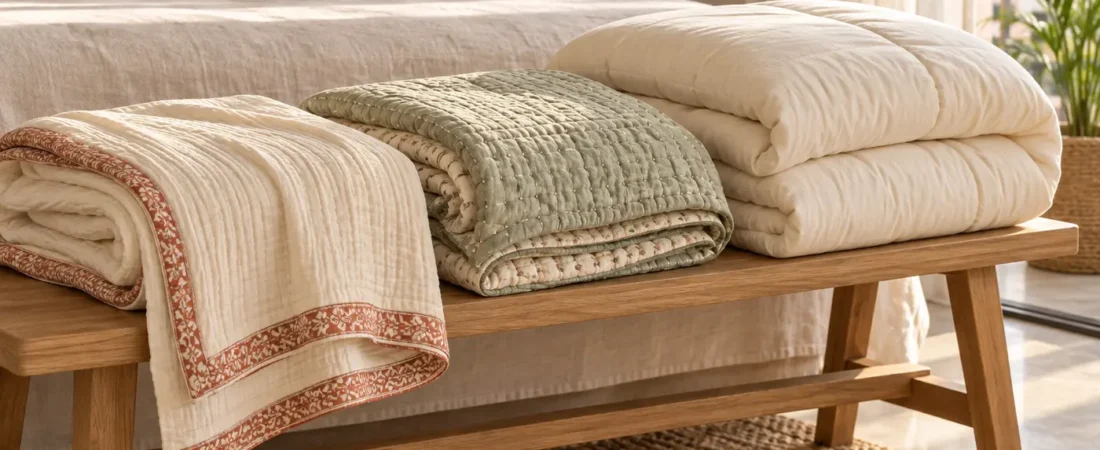
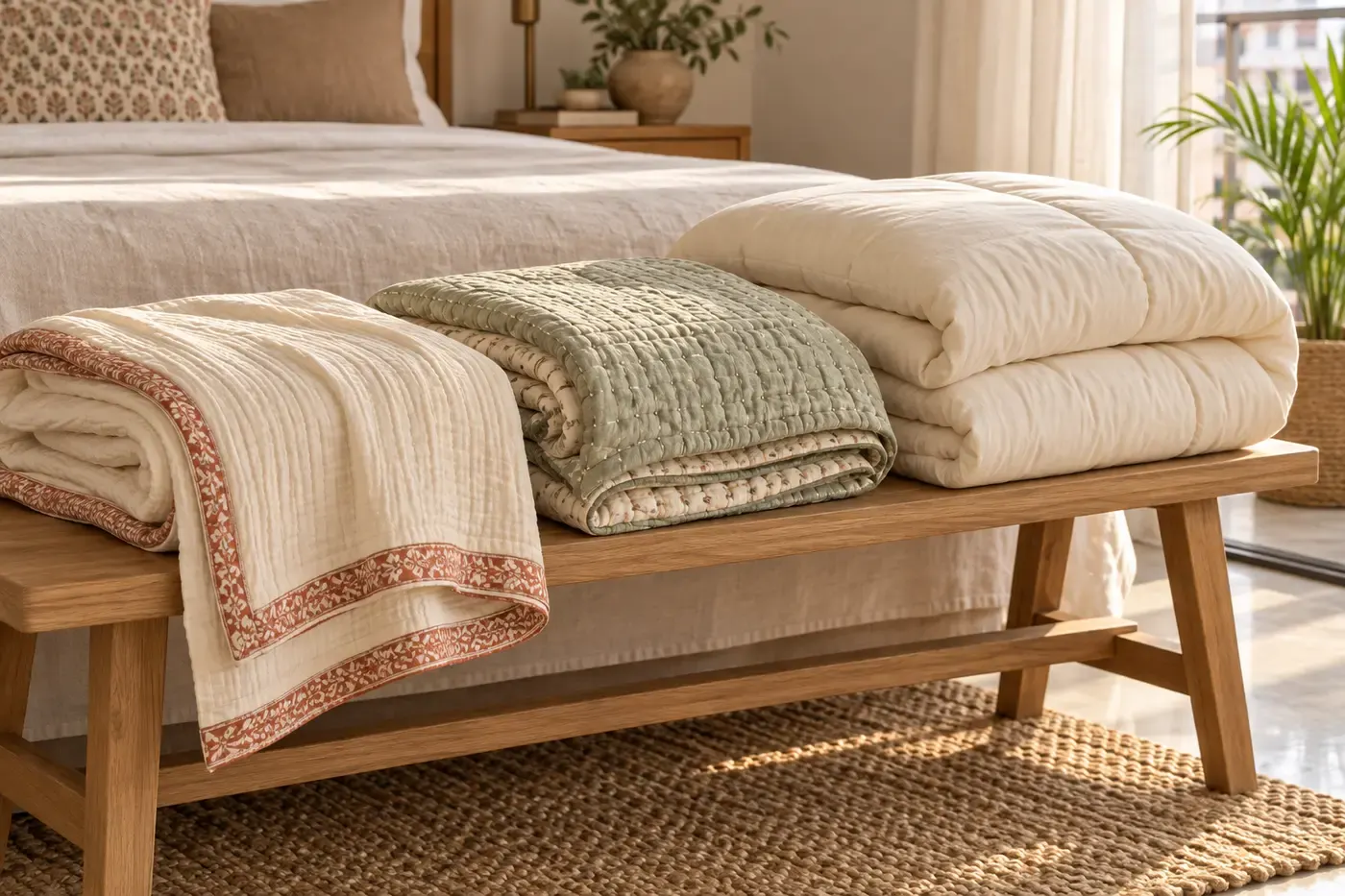
A dohar is usually a light layered cover. A familiar Indian version places a middle layer between two soft outer fabrics; fine cotton muslin, often called mulmul or malmal, is commonly used for the outer faces. However, “three-layer dohar” does not establish the composition of all three layers. Ask what the middle contains and whether the quoted material applies to the whole product or only its exterior.
Imagine lifting the folded edge. Are you holding a thin, flexible cover, or a thick sandwich that feels almost like a quilt? That observation is useful because the same shopping word can cover different weights and constructions. For an online order, request a side photograph, layer description and care instructions instead of assuming that every dohar will feel identical.
What makes a quilt different?
A quilt generally brings together an outer face, an inner layer or filling, and a backing, secured with stitches. The stitching helps keep those layers in position. It may form straight channels, small repeating shapes or a decorative pattern. “Quilted” describes construction; it does not automatically tell you whether the filling is cotton, polyester, wool or another material.
The spacing and condition of the stitches also deserve a look. A quilt with loose sections, broken stitching or uneven filling may need a different care approach from a robust washable design. Ask whether the piece is intended as a daily sleeping layer, a decorative bedcover, or both. That answer changes what you should expect from warmth, flexibility and maintenance.
What does “AC comforter” actually mean?
AC comforter is a retail description rather than one universal warmth specification. One seller may use it for a light polyester-filled cover; another may mean a cotton-shell comforter with a different fill weight. The word does not provide a tested temperature range, an assurance of breathability, or proof that a product will suit everyone sharing an air-conditioned room.
Read the shell material, filling composition, filling weight when available, finished dimensions and washing guidance together. A smooth outer fabric can make an item feel pleasant in your hand while revealing very little about the filling inside. If the description says only “soft fibre,” ask for the actual fibre name before comparing it with a cotton-filled layer.
Where does a cotton-filled Jaipuri razai fit?
Razai or rajai is the name many Indian families use for a filled bedding layer. Jaipuri versions are often associated with a cotton outer and cotton filling, but the term alone cannot verify either material. Confirm the composition of the particular item, whether the cotton is carded, how it is stitched, and whether the filling can be washed at home.
Think of a razai as a candidate for cooler conditions, not a guaranteed solution for every winter. A modestly filled cotton razai and a densely packed one can feel very different. Ask about the weight and intended use, then account for your room’s exposure, the mattress and your sleeping clothes. A product name is the beginning of the conversation, not its conclusion.
Dohar, quilt, comforter and razai at a glance
| Layer | First thing to check | Useful starting situation |
|---|---|---|
| Dohar | All layers, fabric and overall weight | You want a light, flexible cover |
| Quilt | Filling, stitch construction and care | You want a secured, filled layer |
| AC comforter | Actual shell and filling, not the AC label | You want to compare a cover for your cooled room |
| Cotton-filled razai | Confirmed fill, weight and cleaning method | You are exploring a warmer traditional layer |
These are starting points, not fixed warmth rankings. A heavy dohar may feel warmer than a very light quilt. When two descriptions overlap, compare the specifications rather than trying to force them into separate boxes.
Breathability is about the whole bedding system
Cotton can absorb moisture, while fabric openness, density and finishing affect how a layer feels around the body. A fine cotton face does not cancel out a heavy filling underneath it. Equally, a synthetic filling is not automatically unsuitable: design, loft and the room matter. Avoid treating “natural” and “synthetic” as complete temperature specifications.
Cotton Incorporated’s home-textile guidance discusses cotton’s moisture handling and breathability, while also emphasising construction. The practical buying lesson is simple: ask about the complete cover. Then consider the sheet, mattress protector and clothing you will use with it, rather than judging one attractive outer fabric in isolation.
Use room temperature as a starting observation
An AC remote shows a set point, not necessarily the temperature where you sleep. Airflow, room size, outdoor conditions and the location of the indoor unit can make the bed feel different from that number. If temperature is central to your decision, observe the room near bedtime and again toward morning before buying a permanently warmer layer.
| Observed room condition | A sensible trial | What to watch |
|---|---|---|
| Warm, around 26°C or above | Begin with the lightest appropriate cover | Feeling damp, overheated or repeatedly uncovering |
| Moderately cooled, around 23–25°C | Try a light dohar before adding weight | Direct airflow and whether you feel chilly later |
| Cooler, around 20–22°C | Compare a light quilt or adjustable layers | Comfort across the whole night |
| Colder room or winter conditions | Discuss a warmer quilt or razai | Actual fill, clothing and your own comfort |
This is an illustrative shopping checklist, not a validated bedding-temperature chart or a recommended AC setting. People differ. Start with comfort observations rather than deciding that a particular room temperature always requires a specific filling.
Three bedrooms, three different decisions
In a humid coastal apartment, the problem may be a cover that feels heavy even with a fan. Start by reducing unnecessary layers, checking the mattress protector and considering a light dohar with clearly stated materials. Buying a thicker item because it sounds more premium may make that particular problem worse.
In a bedroom where the AC blows across one side of the bed, repositioning airflow or using separate light covers may be more useful than purchasing one heavy comforter for both sleepers. In a cooler northern winter room, a confirmed cotton-filled razai may be worth exploring. The different recommendations follow the room and the people, not a national season label.
What if two people sleep at different temperatures?
Start with the easiest adjustment: two lighter covers rather than one shared heavy one. One sleeper can fold a layer toward the feet while the other keeps theirs up. This also reduces the nightly tugging that happens when a cover is barely wide enough for the bed and two moving bodies.
If you prefer one shared layer, leave a spare light cover within reach for the cooler sleeper. Record which arrangement actually works for several nights. It is a better guide than a label such as “all-season,” which does not know your room, sleepwear or personal preferences.
Choose the finished dimensions, not the bed-size name
A layer that sits neatly on an empty bed may feel narrow once two people get underneath. Measure the mattress width and length, then decide whether you want just top coverage, side drape, or generous shared coverage. Use finished textile dimensions when you compare options. Do not mistake the size of the bed for the size of the cover.
Shaiyaa’s visual size guide shows a dotted bed outline under a transparent finished layer. It helps you see the relationship, but the dimensions on the particular product page remain the buying reference. Ranges can have different usable sizes even when their nominal shopping labels sound alike.
Cleaning can decide which layer is practical
Before choosing a filled cover, ask how you will wash and dry it. A home machine that manages a bedsheet may not be suitable for a wet, filled quilt. Read both the textile’s care label and the machine’s instructions. Never pack a bulky piece so tightly that it cannot move as intended during the cycle.
Drying space matters just as much. If your only drying area is a small shaded balcony, a light washable layer may fit your routine better than an item requiring professional cleaning. For cotton-filled bedding, confirm whether washing is allowed at all. A beautiful product becomes more useful when its care fits the home it is going into.
Build a small, flexible bedding wardrobe
Try beginning with a sheet, one lightweight cover and one warmer option that you use when needed. This gives you combinations for changing conditions without storing a different bulky comforter for every season. Keep the frequently used layer accessible and put seasonal pieces away only when they are completely dry.
Choose compatible finished sizes if you plan to layer them. A small quilt slipping across a much larger sheet can become irritating. You do not need matching prints for every item; one calm base and one expressive layer can make the bed feel considered while leaving room to change the look later.
Questions worth sending before you order
Send a specific enquiry: “My room is moderately cooled and I prefer a light cover. Please confirm the outer fabric, middle layer or filling, weight, usable size and care instructions for this dohar.” If you are considering a razai, add the question of whether the filling is cotton and how it should be maintained.
For Shaiyaa, browse the home-textile collection and ask about current adult dohar, quilt or razai options on WhatsApp. Availability and product details are confirmed before payment. This enquiry route is useful where a category is still being completed online.
A five-night comfort check before your next purchase
For five ordinary nights, notice when you adjust the cover. Do you push it away immediately, wake feeling cold near dawn, or uncover only when the AC starts blowing directly across the bed? Note the room conditions, your sleepwear and which layers you used. Keep the record short enough that you will actually do it.
Then change one thing at a time. Remove the decorative throw, try a lighter cover, or move away from direct airflow. If your existing bedding becomes comfortable after a small adjustment, you have learned something useful without buying another product. If it remains too heavy or too narrow, you can describe that exact problem to a seller. This makes “I need something for AC” a much more useful conversation about weight, coverage and care.
Frequently asked questions
Is a dohar the same as an AC comforter?
No. A dohar describes a type of layered cover, while AC comforter is a broad retail description. Compare actual layers, filling, weight and care before deciding which suits your room.
Are all dohars made from three layers of mulmul cotton?
No. Three-layer mulmul construction is common in some ranges, but materials and middle layers vary. Ask for the composition of the exact product rather than assuming the name confirms it.
Does a cotton filling always sleep cooler than polyester?
No universal rule applies. Filling quantity, loft, outer fabric, airflow, mattress protection and the room all influence comfort. Fibre type is one part of the comparison.
Which bedding is best for an AC bedroom?
Start with how the room feels and how warm you sleep. A light dohar can be a useful first trial; cooler conditions may call for a quilt or an extra layer. AC branding alone is not a temperature rating.
Can I machine wash a Jaipuri razai?
Only if that item’s care instructions permit it and the machine can handle its construction and wet bulk. Some cotton-filled pieces need professional cleaning. Ask before the first wash.
Where should I go next?
Use the Care Guide for everyday maintenance and the introductory dohar, quilt and rajai guide for basic terminology. For a deep mattress, read our measurement guide.