
THE SHAIYAA KNOWLEDGE BASE · SIZE BUYING GUIDES
Quick answer: measure the mattress, including any topper, then add fabric for its depth and the tuck you want. For a flat sheet tucked on both sides, required width equals mattress width plus twice the depth plus twice the side tuck. Length depends on whether you tuck only the foot or both ends. Compare that result with the product’s actual finished size, not just “King” or “Jumbo.”
In this guide
- Begin with three mattress measurements
- What a 10–14 inch mattress changes
- The flat-sheet width formula
- Length: decide what happens at the head of the bed
- A worked example you can adapt
- What 8×9, 9×9 and 10×10 mean in inches
- A square sheet is not automatically generous enough
- Read Shaiyaa’s actual product dimensions
- Use the visual guide as a comparison tool
- Flat versus fitted sheets
- What about shrinking and finishing?
- Pillow covers need their own measurement
- Non-standard cots and family beds
- How to enquire about a custom or unusual size
- Keep units and orientation consistent
- Check the fit before regular use
- Frequently asked questions
The sheet fits beautifully until someone sits on the bed. One corner slips out, the side drape disappears and you find yourself rebuilding the same tuck every morning. Often the problem is not the sheet’s quality. A deeper mattress has simply used up fabric that you expected to sit under the bed.
This guide is for that practical problem. It covers flat bedsheets, fitted-sheet pocket measurements and the large nominal sizes shoppers often call 8×9, 9×9 or 10×10. Those names are convenient shorthand. The tape measure, the desired tuck and the finished textile dimensions make the actual decision.
Begin with three mattress measurements
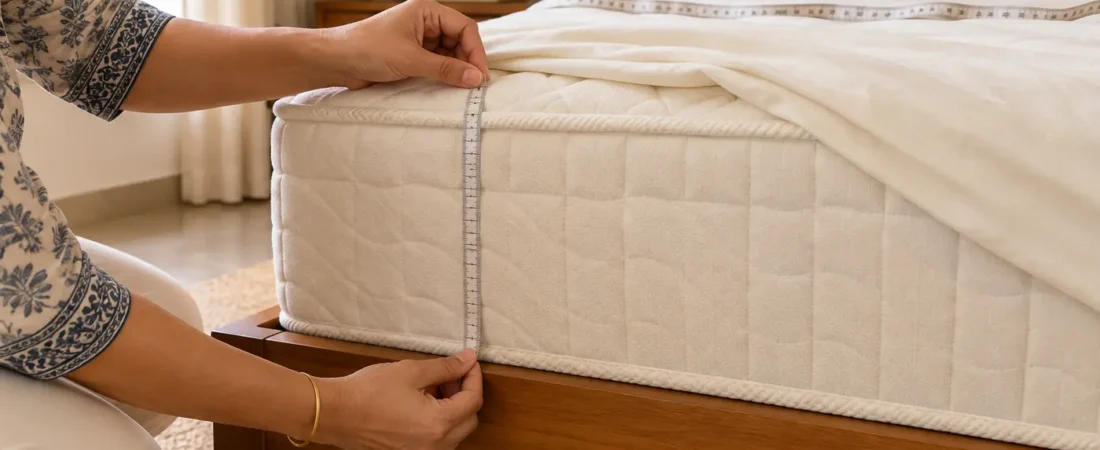
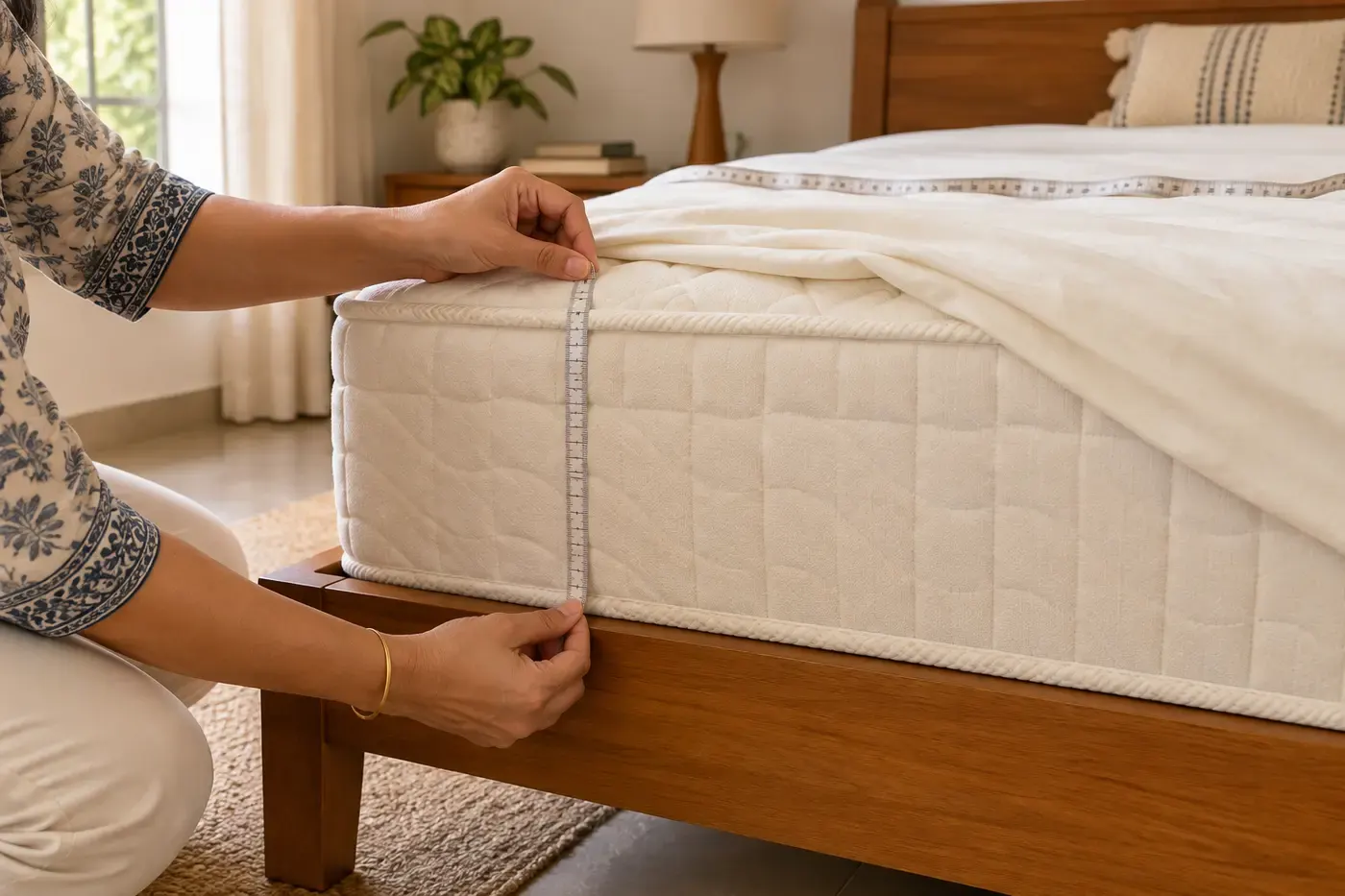
Measure width from side to side, length from head to foot, and depth from the sleeping surface to the underside of the mattress. Measure the mattress itself rather than the outside of the wooden frame. A frame can project beyond the mattress or sit below it, neither of which makes that projection part of the sheet’s sleeping surface.
Take the measurements with any regularly used topper and protector in place. If a pillow-top rises above the sides, include the height you need the sheet to cover. Write the results down in one unit. Mixing centimetres, feet and inches halfway through the calculation is an easy way to order the wrong size.
What a 10–14 inch mattress changes
On a deep mattress, a flat sheet has to travel from the top down each side before there is anything left to tuck. Increasing depth from 6 to 12 inches consumes an additional 6 inches on each side: 12 inches across the width in total. The mattress width can remain exactly the same while the sheet requirement changes substantially.
This is why a sheet that worked on your old bed may feel too small after a mattress upgrade. Photograph the measured depth if you are asking a seller for advice. “King bed” leaves that crucial detail out; “72 inches wide, 78 long, 12 deep, with a topper” gives a useful starting point.
The flat-sheet width formula
Use this planning formula when you want an equal tuck on both long sides: required sheet width = mattress width + 2 × mattress depth + 2 × desired side tuck. The tuck is the fabric you want to go underneath each side after it has covered the depth. It is separate from depth, not another word for it.
For a 72-inch-wide mattress, a 12-inch depth and a chosen 6-inch tuck on each side, the result is 72 + 24 + 12 = 108 inches. The six-inch tuck is an example preference, not a universal requirement. Use the amount that suits your mattress, frame and way of making the bed.
Length: decide what happens at the head of the bed
If the sheet starts flush at the head and you tuck only at the foot, an initial calculation is required length = mattress length + mattress depth + foot tuck. For a 78-inch-long mattress, 12-inch depth and six-inch foot tuck, that gives 96 inches. This assumes no additional fabric is needed at the head.
If you also want to tuck at the head, include that end’s depth and tuck too: mattress length + 2 × depth + head tuck + foot tuck. The same example becomes 78 + 24 + 6 + 6 = 114 inches. Choose the arrangement before comparing products; otherwise two correct calculations can appear to contradict each other.
A worked example you can adapt
| Measurement or choice | Example |
|---|---|
| Mattress width × length | 72 × 78 in |
| Depth including topper | 12 in |
| Desired tuck per side | 6 in |
| Required width | 108 in |
| Required length, foot tuck only | 96 in |
| Required length, both ends tucked | 114 in |
These numbers describe one example. They do not establish a standard Indian king mattress or a promise that a specific sheet fits. Replace each input with your measurements and compare the finished product in the orientation you intend to use.
What 8×9, 9×9 and 10×10 mean in inches
If a seller uses feet literally, 8×9 feet means 96×108 inches, 9×9 means 108×108, and 10×10 means 120×120. These are textile dimensions, not necessarily mattress dimensions. They may describe a nominal fabric size before finishing rather than the usable piece that arrives.
Names such as Super King, Super Double, Jumbo, Grand Family and Maharaja are not used consistently across shops. Shaiyaa’s Super Double listing, for example, should be read through its specific stated measurements rather than assumed to be an exact 8×9-foot textile. Always ask the seller to translate the label into finished width and length.
A square sheet is not automatically generous enough
A nominal 9×9-foot sheet sounds expansive, but finishing can leave a smaller usable piece. If your width calculation requires 108 inches, a finished sheet measuring 104 inches across does not supply those missing four inches. You might accept a smaller tuck; you should make that decision consciously instead of discovering it at bedtime.
The same applies to a nominal 10×10-foot family bedsheet. Ask for the final usable size and check both dimensions. A larger square can offer flexibility, but it still has to cover your mattress depth, your chosen tuck and any constraints created by a recessed frame or wall-side access.
Read Shaiyaa’s actual product dimensions
Current product listings illustrate why the range matters. Vibrant lists a usable size of 93×104 inches; Alankar lists 87×104; Samridhi lists 104×106; Real Rajwada lists 104×104. Similar-sounding size labels do not make those numbers interchangeable. Open the specific product page again before confirming your choice.
Compare Vibrant, Alankar, Samridhi and Real Rajwada using their listed dimensions, fabric and pillow covers. These are product examples, not a recommendation that any one fits the worked mattress above.
Use the visual guide as a comparison tool
The Shaiyaa Size Guide places a dotted purple reference bed under a transparent finished sheet. Width and length markings show which outline belongs to which object. It is a flat comparison, so the visible excess fabric is not all free tuck: some of it will travel down the mattress sides.
Reference beds are illustrations rather than a claim that all king or queen mattresses have those dimensions. Use your own measurements for the order. Product-specific usable sizes take priority over a generic category illustration, and a fixed subtraction rule should not replace the actual finished specification for your range.
Flat versus fitted sheets
A flat sheet is a rectangular textile that you arrange and tuck. A fitted sheet uses shaped corners and elastic to hold around a mattress. For fitted sheets, check the stated mattress width, length and pocket depth, including any recommended depth range. A broad flat-sheet measurement cannot be used as a fitted-sheet pocket specification.
Neither choice is automatically better. A flat sheet can be easier to fold and more flexible across different beds; a well-matched fitted sheet can simplify making a particular mattress. If a listing does not state which construction it uses, ask. Do not assume that a large cotton bedsheet includes elastic corners.
What about shrinking and finishing?
Keep three questions separate: the nominal fabric size, the finished size supplied by the seller, and any change expected through laundering. Do not subtract an arbitrary percentage from every cotton product or assume that all makers allow the same amount for hems. Ask whether quoted measurements are before or after washing and follow the care instructions.
If a fit is marginal on paper, request guidance before ordering. A few extra inches may matter more than a particular label. Keep the seller’s confirmed measurements in your order conversation, especially for a deep mattress, a non-standard cot or a sheet you intend to tuck on every side.
Pillow covers need their own measurement
Measure the pillow you actually use and compare it with the cover dimensions and opening style. A flap cover and a zip cover can behave differently when you insert a plump pillow. Do not assume that every double bedsheet includes the same cover size, the same number of covers, or the pillows shown in the photograph.
Shaiyaa product pages provide set details for each range. Add a pillow-cover question to your size enquiry so the whole set works together. If you use unusually large or shaped pillows, say so. Solving the bedsheet width while overlooking the pillow covers leaves half the practical fit discussion unfinished.
Non-standard cots and family beds
For a custom-made wooden cot, measure the sleeping surface rather than relying on the carpenter’s description. Check whether the mattress is recessed and whether you can reach all sides comfortably. These details influence how much tuck you can use in practice, even when the arithmetic allows a generous amount.
For a family bed made from two adjoining mattresses, record the overall width and each mattress’s height. Decide whether you want one large flat sheet or separate sheets. A joint between mattresses and different heights can affect how a single textile sits. Describe the setup honestly instead of choosing only by a “family” product label.
How to enquire about a custom or unusual size
Use Shaiyaa’s size enquiry to share width, length, depth, preferred tuck and required quantity. Ask whether a suitable existing size or a special-size arrangement is available. Custom production, pricing and lead times need confirmation; this guide does not promise that every dimension can be made.
If you are buying several sets for a homestay or business, include the number of mattresses and any different sizes. The B2B enquiry page lets you describe quantities and timing. A written measurement list is far more useful than a collection of labels such as king, super king and extra large.
Keep units and orientation consistent
One foot equals 12 inches, and one inch equals 2.54 centimetres. If your tape uses centimetres, keep the whole calculation in centimetres or convert every measurement before starting. Do not add an inch-based tuck to a centimetre-based mattress width. Label each number in the message you send to the seller.
Write width first and length second throughout your comparison. On a rectangular sheet, swapping those values changes the available side coverage. A border or directional motif can also make one orientation preferable even when turning the sheet appears to solve the arithmetic. Ask for an overhead product photo if the direction is unclear, and confirm the intended top edge before choosing a size that only works when rotated.
Check the fit before regular use
Review the seller’s inspection and return policy before opening, washing or using the item. Compare the supplied set and listed dimensions with your order. If something appears wrong, contact the seller with clear photographs and the product name. Do not cut, alter or wash a potentially incorrect piece while trying to make it work.
Once you are satisfied and the care label allows preparation before use, follow that guidance. Keep your mattress measurements for the next order. The small effort of measuring once can save repeated uncertainty whenever you change a mattress, add a topper or buy a different textile range.
Frequently asked questions
Is a 9×9 bedsheet always 108×108 inches usable?
No. That may be its nominal size. Ask for finished usable dimensions and compare them with your mattress-and-tuck calculation.
How much extra width does a deep mattress need?
For equal side tucks, add twice the mattress depth and twice the chosen tuck to the mattress width. A 12-inch depth alone uses 24 inches across both sides.
Can I turn a rectangular sheet sideways?
You can compare that orientation if the print, borders and set design allow it. Check both resulting dimensions and ask whether the design is intended to run in a particular direction.
Does a larger flat sheet mean it is fitted?
No. Fitted construction needs explicit confirmation, including pocket depth and elastic details. A flat sheet remains flat regardless of its size.
Are Super King and Super Double standard sizes?
Not consistently across sellers. Use the exact product measurements instead of treating either name as a universal mattress specification.
What should I send Shaiyaa for size help?
Send mattress width, length, depth with topper, desired tuck, product name and pillow measurements. Add quantity and timeline for a special-size enquiry.