
THE SHAIYAA KNOWLEDGE BASE · DINING LIVING
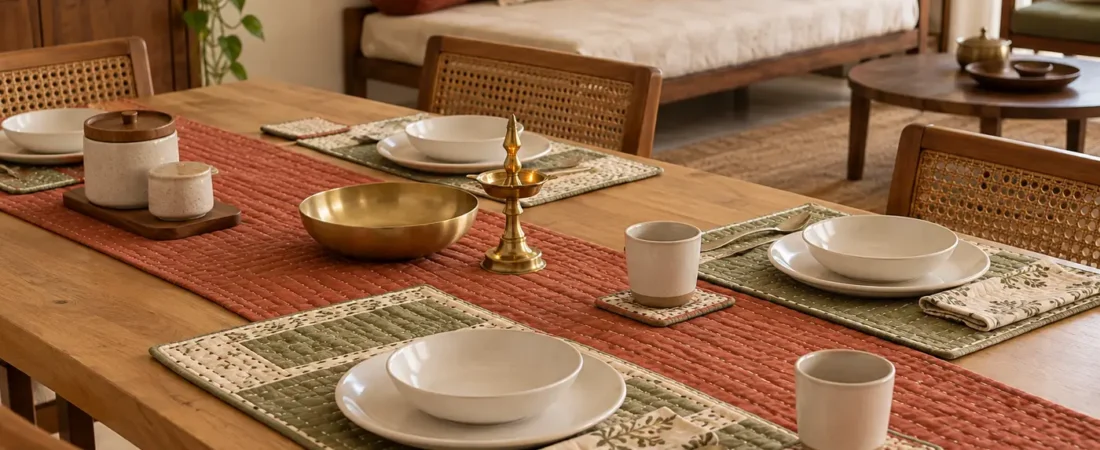
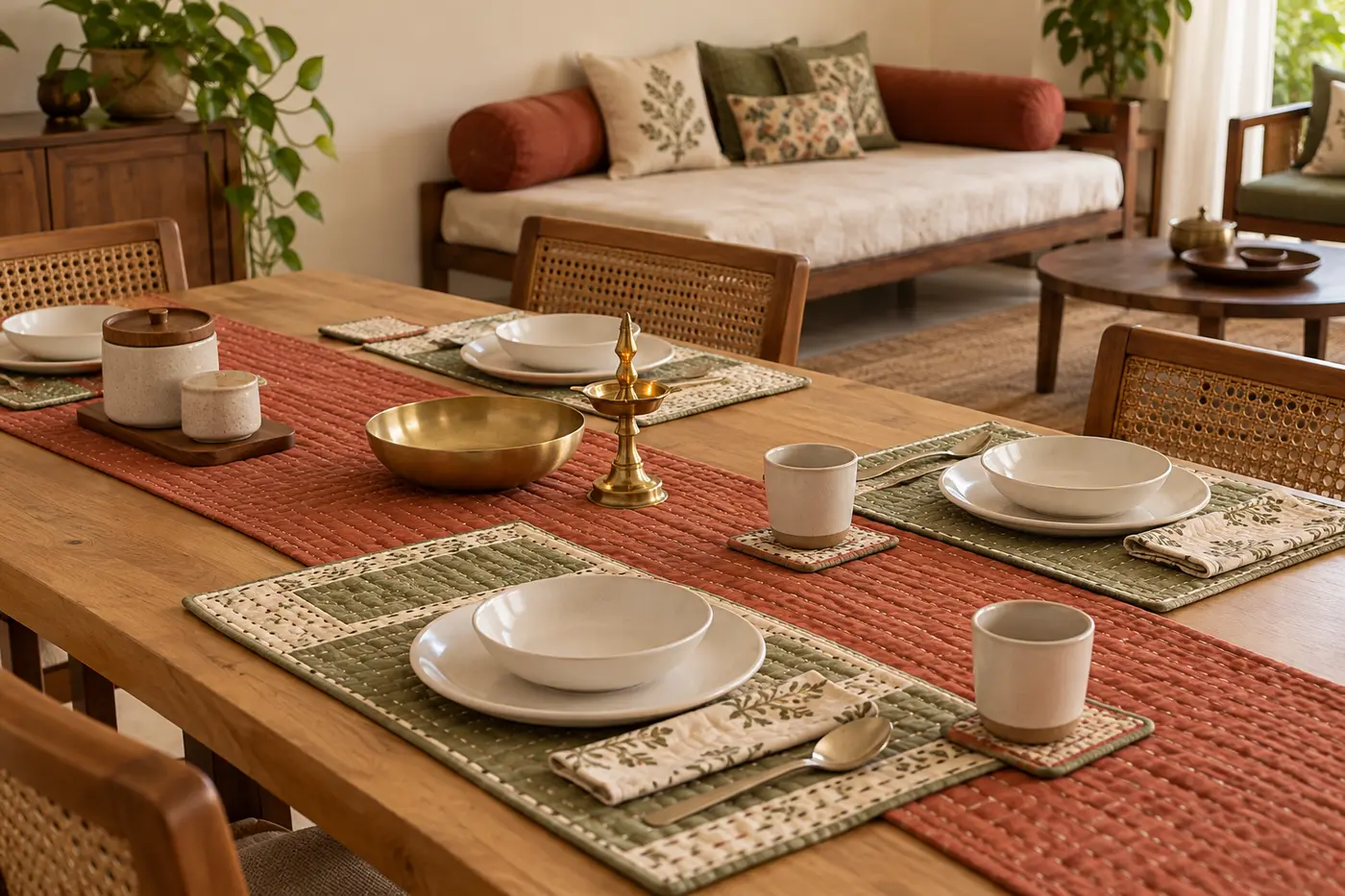
How do you style a table with artisanal textiles? Begin with the table measurements and serving space. Choose one lead pattern, repeat a colour in simpler supporting pieces, and leave room for plates, glasses and shared dishes. Carry that colour into the living area through a cushion or bolster rather than covering every surface in the same print.
In this guide
- Start with the occasion and the people
- Measure the table before buying a runner
- Build a simple three-part palette
- What quilted runners add to a table
- Understand kantha without reducing it to a pattern
- Place mats, coasters and serving dishes in that order
- Three layouts you can adapt at home
- Make festive decor feel warm rather than crowded
- Connect the dining room to a deewan corner
- Measure deewan covers and bolster slips correctly
- Shop the look by function, not by an unavailable bundle
- Choose a realistic care routine
- Build the room in stages
- Frequently asked questions
A welcoming table rarely begins with a perfect photograph. It begins with someone asking whether there is enough room for one more plate. A beautiful runner can help set the mood, but the generous feeling comes from a setting that works when people actually sit down, pass food and talk.
This guide brings together dining table styling, quilted runners, kantha-style mats, coasters and coordinated deewan sets. These are design suggestions, not a promise that every illustrated item is currently stocked. Where a specific textile is unavailable, use the same principles with pieces you own or ask Shaiyaa about the current selection.
Start with the occasion and the people
Before choosing a colour, decide what the room needs to do. A weekday breakfast for two needs a different arrangement from a birthday lunch for eight. Will food arrive in individual portions, or will several large serving dishes stay on the table? Will children need clear space? Is the table also the family workspace before dinner?
Write one sentence describing the occasion: “A relaxed family lunch with shared dishes,” or “A festive evening with a clear central serving space.” This becomes a useful editing rule. If an accessory makes that sentence harder to fulfil, leave it out. The result usually looks calmer because each object has a reason to be there.
Measure the table before buying a runner
Record the tabletop length and width, then check the runner’s finished dimensions. A runner may sit entirely within the tabletop or extend beyond its ends, depending on the design and your preference. Do not assume that a photograph shows the same table proportions as yours. Tape or folded newspaper can help you preview the footprint before ordering.
For example, a table 150 cm long with a chosen 15 cm drop at each end needs a runner about 180 cm long. That is a styling calculation, not a universal standard. If a child might pull an overhanging textile, a shorter arrangement contained on the tabletop may suit your household better.
Check the width with plates in position. A broad runner that overlaps every setting can look crowded and catch crumbs beneath the edges. A narrow runner may leave more wood visible and give a busy print room to breathe. Neither is inherently more luxurious; the better proportion is the one that allows comfortable use.
Build a simple three-part palette
Choose a quiet base, one principal colour and a small accent. On a wooden table, the wood itself can be the base. A cream-ground floral runner might introduce muted terracotta, while plain napkins repeat its warm tone and a small bowl brings in a little green. You do not need three new purchases to make this work.
Look at the undertones already in the room: warm wood, cool stone, brass, painted cabinets or a patterned floor. Select a textile that belongs comfortably among them. If the room contains several strong patterns, try a quieter dining textile. If the room is spare, the runner can carry more visual detail.
Matching every item exactly can make a room feel less personal. Instead, repeat a colour at different scales: a fine motif on the runner, a narrow border on the mat and a plain cushion nearby. The connection remains visible while the individual pieces retain their character.
What quilted runners add to a table
A quilted runner brings a little texture and a softly structured surface. It can make a simple table setting feel considered without needing a full tablecloth. Check how thick the quilting is, whether the edges lie flat and whether the piece can be cleaned in a way that suits your routine.
Quilting does not automatically make a textile heatproof, waterproof or stain resistant. Use suitable trivets beneath hot cookware and protect surfaces according to the furniture manufacturer’s guidance. A decorative runner is not a substitute for a purpose-made heat barrier. Similarly, a padded surface should not make glasses or candleholders unstable.
When shopping, ask about face fabric, backing, filling and care separately. “Cotton runner” may describe only one component. Clear construction information helps you judge whether the piece suits everyday dining or occasional use, especially if you expect to wash it frequently.
Understand kantha without reducing it to a pattern
Kantha belongs to a rich textile tradition associated with Bengal and Bangladesh. The Victoria and Albert Museum’s introduction explains its quilting heritage and the way the term is also used for a stitching style today. A contemporary placemat described as kantha should still have its own materials and making method explained.
Ask whether a mat is hand stitched, machine stitched or simply printed with a stitch-like design. Those are different products, even when the colours look similar online. The useful question is what you are buying, rather than whether an irregular line alone proves authenticity.
For styling, the quiet rhythm of running stitches can balance a more elaborate floral print. Allow the texture to remain visible: a mat almost completely covered by an oversized plate cannot contribute much to the setting. Try your everyday crockery against the proposed mat dimensions before choosing a set.
Place mats, coasters and serving dishes in that order
Begin with the seating positions. Place a plate at each setting and check that neighbours have enough elbow room. Add mats if they improve the arrangement, followed by glasses and coasters. Only then decide how much room remains for a runner, flowers or decorative objects.
For shared meals, imagine the largest serving bowl actually moving across the table. Keep its path clear. A low, compact centre arrangement is often easier to live with than several tall ornaments. Guests should be able to see one another and reach food without rearranging the room.
Coasters can repeat a colour without copying the runner’s entire pattern. Check that their surface is suitable for the glassware you use and that any care instructions are realistic for daily spills. Buy the number your household needs, with an extra pair only if it will genuinely get used.
Three layouts you can adapt at home
| Occasion | Textile approach | Keep clear |
|---|---|---|
| Everyday breakfast | Two simple mats, a small tray and optional short runner | Space for mugs, newspapers and quick clearing |
| Family lunch | One lead runner with quiet supporting napkins or mats | A generous central lane for serving dishes |
| Festive dinner | A considered palette with textured accents and a low centrepiece | Sightlines, stable glassware and serving access |
These layouts are starting points. A small round table may work beautifully with individual mats and no runner at all. An extendable table may need a different arrangement when opened. A setting that adapts to your furniture is more useful than one built around a fixed photographic formula.
Make festive decor feel warm rather than crowded
For a festive meal, let one element carry the occasion. It might be a deeper coloured runner, a small flower arrangement or a special tray used to welcome guests. Supporting items can remain familiar. This makes it easier to reuse the textiles after the celebration rather than storing a complete themed set for a single evening.
Keep open flames away from textiles and use stable, suitable holders; flameless lights can be a practical alternative. Avoid placing loose decorations where they might fall into food. The aim is to make people comfortable, including the person who will clear the table afterwards.
Before guests arrive, sit in each position for a moment. Can you see across the table? Is a border catching on your sleeve? Does the setting still work once the water jug arrives? These small checks often improve the experience more than adding another ornament.
Connect the dining room to a deewan corner
A deewan can become the quieter companion to a lively dining arrangement. Instead of repeating the full runner print, pick one colour from it for the deewan cover, cushion border or bolster slips. A botanical table setting might connect to a plain sage cushion; a warm geometric runner might sit naturally beside a rust accent.
First identify what your deewan actually needs: a mattress cover or sheet, rectangular cushions, cylindrical bolsters, or a complete coordinated set. Retail descriptions vary, so never assume a photographed arrangement lists every included piece. Ask for the pack contents and the dimensions of each component.
If Shaiyaa does not currently list the exact deewan set you want, send an enquiry with measurements and a reference palette. An enquiry is a request to check options, not confirmation that a custom set can be produced. Availability, quantities, making method and timelines must be confirmed before payment.
Measure deewan covers and bolster slips correctly
Measure the deewan mattress length, width and depth, including any topper. Decide whether you need a loose drape, a tucked finish or a specifically fitted cover. A flat textile must provide enough material to travel down the sides and remain secure; a fitted cover must match the actual mattress and fastening design.
For cylindrical bolsters, note the length and circumference as well as the closure arrangement. If a seller specifies diameter, provide that measurement too and confirm which dimension the listing uses. A circular end and a long cylindrical body are not interchangeable measurements. For square cushions, check the cover’s finished size against the insert.
Label your measurements clearly in inches or centimetres and keep the units consistent. A simple photograph with a tape in place can help resolve an uncertain edge. For deeper mattresses and flat-sheet calculations, use the size guide and the detailed sizing article.
Shop the look by function, not by an unavailable bundle
Start with the Dining Experience collection to see the current range. Explore the dining table cover and dining table set pages, checking the individual listing for what is included. These links are browsing pathways, not a preconfigured bundle with a guaranteed combined price.
A wooden tray set or mango wood tray set can support the welcome or serving ritual. Check dimensions and finish before deciding how it will be used. Do not assume any decorative tray is approved for direct food contact unless the listing confirms that use.
To assemble a coordinated look, share the table dimensions, seating count, preferred colours, quantities and delivery location through How to Order. Ask for current photographs and an itemised selection. That keeps the room cohesive while allowing you to approve each piece individually.
Choose a realistic care routine
Dining textiles meet oil, spices, drinks and frequent handling. Before buying, consider whether you can follow the stated wash and drying instructions. A pale, occasional-use runner may be lovely for a careful dinner but less practical as the family’s only daily surface. Keep a simpler rotation if that suits your household.
Follow the care label for each piece rather than washing the whole coordinated set together automatically. A quilted runner, stitched mat and fabric-covered accessory can have different construction and colourfastness requirements. Test any recommended stain treatment on an inconspicuous area and avoid improvising strong chemical mixtures.
Use the care guide and printed textile care article for general principles, while allowing the product’s specific instructions to take priority. Dry textiles fully before storing them so the next celebration begins with pieces ready to use.
Build the room in stages
If you are starting with a limited budget, choose the item that solves the largest visible or practical gap. That may be a properly sized table cover rather than a decorative runner, or new bolster slips rather than a full living room change. Use existing plain crockery and cushions to support it.
After a few meals, notice what you reach for most. Perhaps the tray makes serving easier, while the extra mats stay folded away. Let that experience guide the next purchase. A home develops more character when choices reflect actual routines, rather than a single large order made before you know what works.
Photograph the room in ordinary daylight before adding anything else. This helps you see where a little contrast is useful and where the room already feels complete. You can keep the photograph as a reference when asking about future colours, without expecting a screen to reproduce every shade perfectly.
Frequently asked questions
Can I use a runner and placemats together?
Yes, if the table has enough space and the edges lie comfortably. Test the arrangement with your real plates and serving dishes. A runner with plain mats or textured mats with a quieter runner usually gives each element room to be seen.
Are quilted runners safe for hot pots?
Do not assume so. Quilting is a construction detail, not a heat-resistance certification. Use appropriate trivets and follow the runner and furniture care instructions. Check that all serving pieces remain stable on the surface.
Does kantha always mean handmade?
No retail word should replace a clear making description. Ask whether the item is hand stitched, machine stitched or printed with a stitch-like motif. Confirm the face fabric, backing and care instructions as well as the technique.
How do I coordinate a deewan set with dining textiles?
Repeat one colour or a small border detail rather than the entire print everywhere. Measure the mattress, cushions and bolsters separately, and confirm exactly which covers a quoted set includes before ordering.
Can Shaiyaa create a complete tablescape bundle?
Ask the team to check current items and prepare an itemised selection. This guide does not advertise a fixed bundle, a custom-making service or guaranteed stock. Availability, price and timing need confirmation for your request.
What information should I send for gifting or bulk decor?
Share the occasion, quantity, budget, delivery destination and required date through the B2B enquiry page. Mention packaging needs and any desired coordination. Ask what can be supplied before committing to an event plan.