
THE SHAIYAA KNOWLEDGE BASE · JAIPUR CRAFT HOME
Quick answer: Sanganeri printing is often associated with delicate floral motifs on pale grounds; Bagru has its own earthy palettes, direct-print and resist traditions, including dabu. Neither a colour scheme nor a photograph proves where or how a textile was made. Look for product-specific provenance and printing information; reverse-side colour and small repeat variations are clues, not conclusive tests.
In this guide
- Begin with place, method and material
- What is Sanganeri hand-block printing?
- What is Bagru printing?
- Sanganeri and Bagru: a careful comparison
- How wooden blocks build a pattern
- What is dabu mud-resist printing?
- Can the reverse side prove hand-block printing?
- What do soft edges and small variations tell you?
- A five-part provenance check
- Hand printing and machine printing are not moral opposites
- How to choose a craft-inspired print for your room
- Check the product beneath the story
- Dyes, care and safety claims require their own evidence
- A message you can send before ordering
- Buying a printed textile as a gift
- Build a collection with context
- Frequently asked questions
You fall in love with a tiny flower on a cotton bedsheet, then notice three different descriptions across three shops: Jaipuri, Sanganeri and hand-block printed. The words sound related, but they do different jobs. One can indicate a regional association, another a particular place and tradition, and the third a production method.
Learning the distinctions makes textile shopping richer. It also helps you avoid paying for a craft story that the seller has not actually established. This guide offers a way to appreciate Rajasthan’s printing vocabulary while asking precise, respectful questions about the piece you plan to bring home.
Begin with place, method and material
Separate three questions before evaluating a textile. Where was it made? How was the pattern applied? What is the fabric and colouring system? The answer to one does not automatically answer the others. A cotton textile can be machine printed; a hand-printed textile can use different kinds of colour; a traditional-looking motif can be reproduced far from its historical centre.
Write those three questions beside the product name. If the seller knows only the fabric, that is useful but incomplete information. If the seller provides the printing location and method, keep the statement with your order. Clear language gives both the buyer and maker more credit than an attractive but vague story.
What is Sanganeri hand-block printing?
Sanganer, near Jaipur, is associated with fine floral printing and light grounds. The government’s Sanganeri craft reference describes delicate butis and butas among its familiar motifs. These associations provide context, not a photographic certificate for every white floral bedsheet.
In a bedroom, a small repeating flower can read almost like texture from the doorway. A larger flowering vine can become the focal point. You may choose either visual effect without claiming specialist expertise. The important shopping distinction is between liking a Sanganeri-inspired design and being told that a specific item was produced through a documented Sanganeri hand-printing process.
What is Bagru printing?
Bagru is another Rajasthan printing centre with a distinct craft history. Its traditions include direct printing and resist processes, and its designs are not limited to geometric forms. The government’s Bagru craft reference also describes floral motifs and varied colour practices.
This matters because a simple “Sanganeri equals flowers, Bagru equals geometry” rule loses too much. Contemporary makers develop new palettes and products, and visual influences travel. A brown ground or an indigo repeat can suggest questions to ask, but cannot establish a village, community or manufacturing method by itself.
Sanganeri and Bagru: a careful comparison
| Starting point | Sanganeri associations | Bagru associations |
|---|---|---|
| Place | Sanganer near Jaipur | Bagru in Rajasthan |
| Often-seen visual language | Fine botanical motifs and pale grounds | Earthy palettes, florals and varied repeat forms |
| Questions to ask | Actual origin, method and colour system | Actual origin, direct or resist process, colour system |
| What appearance cannot prove | That every floral was hand printed | That every earthy or indigo print is Bagru |
Use this as orientation rather than a strict classification key. A thoughtful seller should be able to explain whether a name describes style, provenance or both.
How wooden blocks build a pattern
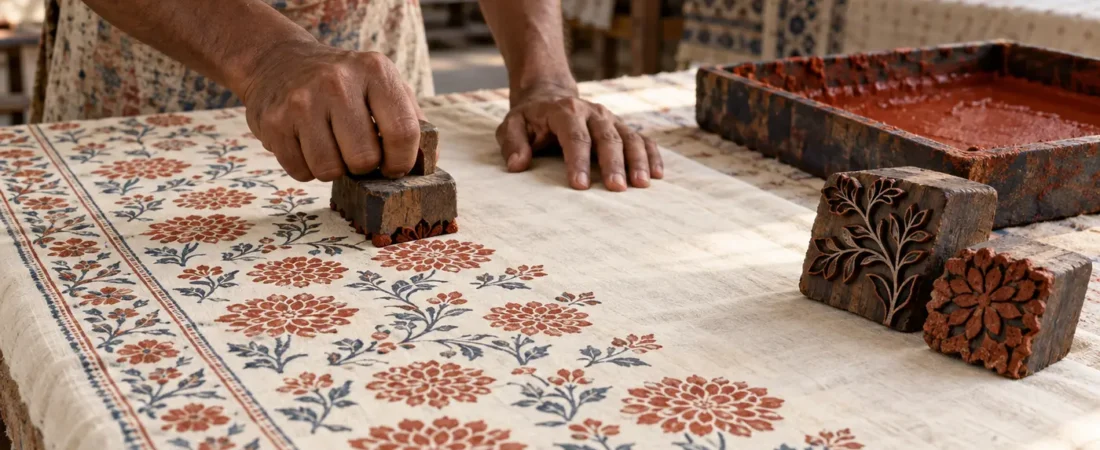
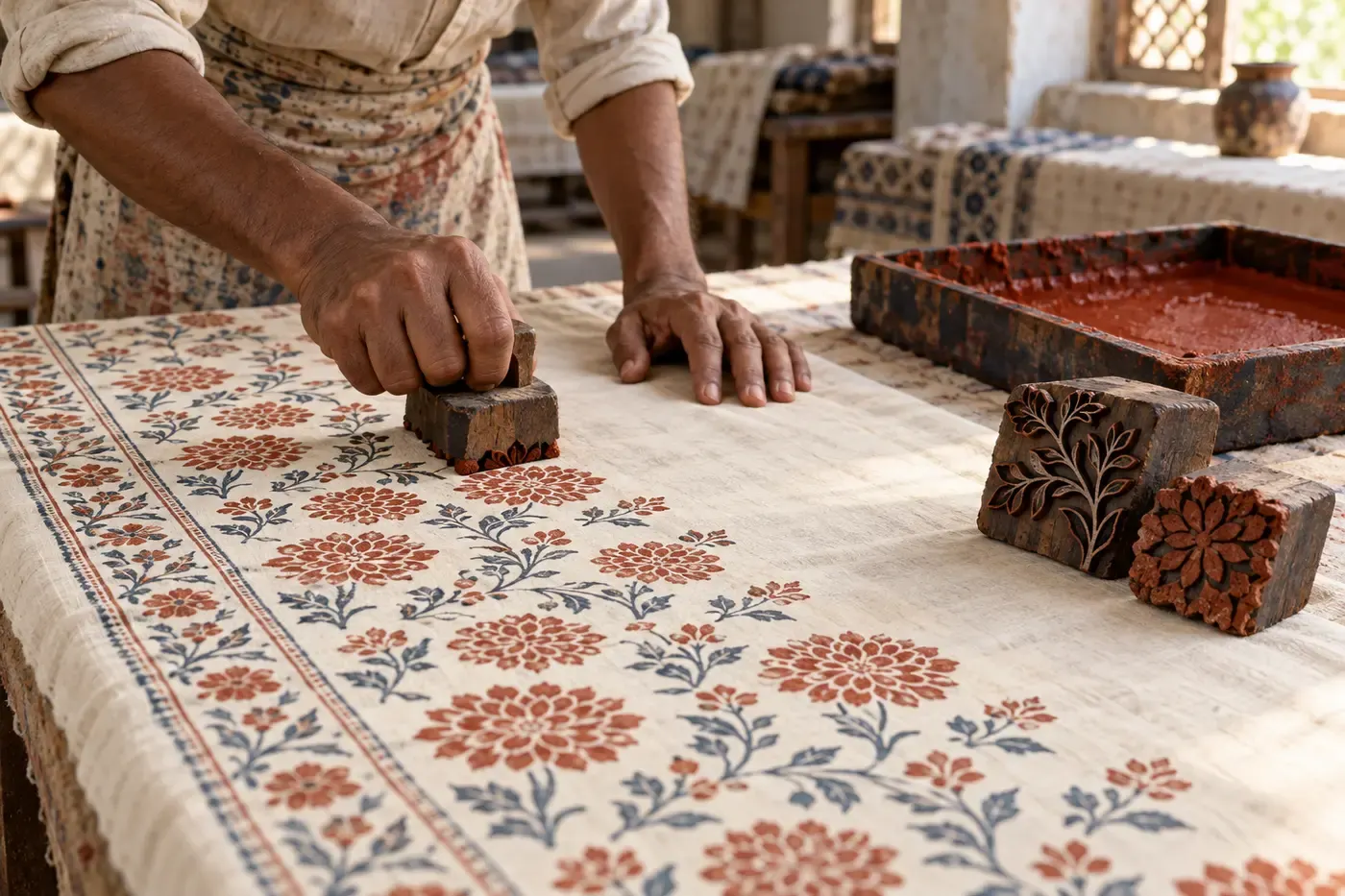
A multi-colour repeat can require separate blocks for different design functions. Rekh refers to outline work, gadh or gad to background areas, and datta or related spellings to filling or detailing. D’Source’s block-purpose documentation explains these roles and shows how different blocks contribute to a complete motif.
Do not assume every design uses exactly three blocks or follows one unchanging sequence. A more complex colour arrangement may need additional blocks, and printing order depends on the process. When a seller describes outline, ground and fill stages, ask whether that explanation documents the product or simply introduces the craft in general.
What is dabu mud-resist printing?
In a resist process, selected areas are protected so that later dyeing creates a contrast. Dabu uses a resist paste associated with mud-based printing practice. The Museum of Art & Photography’s Bagru explanation describes direct and dabu stages as processes that can be combined and repeated according to a design.
A useful way to look is to ask where the coloured ground stops and the reserved area begins. Fine irregular effects can be part of a process, but they are not a complete test of authenticity. Reproductions can imitate visual texture, while skilled handwork can be remarkably consistent. Ask how the particular textile was made.
Can the reverse side prove hand-block printing?
Turn a textile over if you can, but treat the result cautiously. The reverse can help you understand whether colour appears through the cloth and how the face differs from the back. It does not, on its own, identify the tool that applied the design. Fibre, colour chemistry, fabric weight and processing all influence appearance.
For an online purchase, ask for a photograph of the actual reverse beside the face. If the seller supplies only another styled bed image, repeat the request clearly. The aim is better product information, not a household laboratory experiment. Avoid rubbing, soaking or applying chemicals to a new item as an improvised authenticity test.
What do soft edges and small variations tell you?
Look at a close-up of a repeat junction, an outline and a filled area. Slight differences may invite questions about block placement, colour application or finishing. But a small irregularity is not automatically valuable craftsmanship, and a precise repeat is not automatic evidence of machine production.
Ask the seller which variations are expected and which are considered defects. A tiny registration shift described in advance is different from an unexplained stain or damaged seam. This question protects the maker’s character without using “handmade” as a blanket excuse for every problem a buyer might find.
A five-part provenance check
First, ask for the printing method of the exact design: hand block, screen, digital or another process. Second, ask where printing took place. Third, request material and care details. Fourth, ask whether the photographs represent the exact piece or a sample. Fifth, ask what evidence supports a specific craft, dye or certification claim.
You do not need to demand a dramatic workshop story or personal information about an artisan. A concise, consistent product statement is already useful. If a seller cannot verify provenance, they can describe the design as inspired by a tradition. That keeps the conversation honest while allowing you to enjoy the textile on its own visual merits.
Hand printing and machine printing are not moral opposites
Different methods can serve different needs. A buyer might choose hand printing for its craft process, a screen print for a particular repeat, or a digital print for a design unavailable through another route. The basic requirement is that the product description accurately represents the method.
A machine-printed floral does not become unacceptable because it resembles a traditional motif. It becomes misleading if it is sold as verified handwork without support. Likewise, genuine hand printing should not be reduced to “imperfect fabric.” Discuss the method, design, construction and condition separately so that each receives fair consideration.
How to choose a craft-inspired print for your room
Start with the room’s existing patterns. Strong curtains and a patterned rug may sit more comfortably with a small repeat on the bed. In a quieter room, a broad botanical motif or a clear border can provide character without additional ornaments. Consider the view from the doorway, not only a close-up on your phone.
Choose one colour to repeat elsewhere, perhaps in a cushion or lampshade, rather than matching every object. A border can frame the mattress attractively, but its placement should make sense for your sheet orientation. Ask for a full-spread image if only a folded sample is shown. You need to understand both the centre and the edge.
Check the product beneath the story
A compelling craft explanation does not replace usable dimensions, fibre composition or pillow-cover details. Measure the mattress and compare the sheet’s finished size. Confirm the number of covers, their dimensions and whether their openings are zipped or flapped. Ask which props in the photograph are excluded from the set.
Read the general Jaipuri bedsheet buying guide for the broader checklist, and use the visual Size Guide to understand coverage. The print story makes the product meaningful; practical information makes it easy to use.
Dyes, care and safety claims require their own evidence
Hand-block printed does not automatically mean natural dyed, azo-free, organic or certified for a particular use. Those are separate claims. Ask for the documented colour system or relevant testing where the seller promotes it. A muted earth palette cannot establish chemistry, just as a vivid shade cannot tell you everything about safety.
For washing, follow the item’s care label and the printed-bedding care guide. Do not try to fix an unknown dye with an unapproved salt or vinegar soak. If instructions are missing, ask the seller before washing. The appropriate care depends on the actual textile, not its regional-looking motif.
A message you can send before ordering
Try: “I like this design. Please confirm whether this exact bedsheet is hand block printed, where it was printed, its fibre composition and its finished size. Are small variations expected? Can you share a full-spread photo, a close-up and the reverse, plus the care instructions?” Add any question about dye testing that matters to you.
For Shaiyaa, ask about the specific design before payment. Browse the collection for visual choices, while checking that the product’s wording distinguishes documented handwork from a handblock-printed design description or influence.
Buying a printed textile as a gift
For a gift, prioritise a piece the recipient can use without a complicated care routine. Check the finished size against what you know about their bed or dining table. If you do not know the measurements, a smaller lifestyle textile may be easier to choose than a fitted item or a large bedsheet set.
Include the care instructions and a short factual note about the design. Avoid adding claims such as “natural dyed” or “made by a particular artisan” unless those details came with the product. A thoughtful gift can tell a modest, accurate story: what the textile is, how the seller says it was printed and why its colours reminded you of the recipient’s home.
For bulk gifts, ask whether all pieces will share the same design and whether small shade or placement variations are expected. Confirm the final combination, packing and deadline before paying. The Shaiyaa B2B page has a gifting route for that discussion; it does not imply that every textile can be customised or supplied in unlimited quantities.
Build a collection with context
You do not have to replace a whole room to enjoy a textile tradition. Begin with one useful piece whose dimensions and care suit your home. Notice how its motif reads in daylight, how the border frames the bed or table, and whether it works with things you already own.
Keep the maker or seller’s product information with the piece. When someone admires it, you can share what you actually know: the stated printing method, the region or the design influence. That modest precision is more respectful than repeating an elaborate origin story that nobody has established.
Frequently asked questions
Are all pale floral prints Sanganeri?
No. Pale floral designs are associated with Sanganeri visual language, but appearance alone does not prove location or hand-printing method.
Is Bagru always geometric or always dabu?
No. Bagru traditions include floral forms and both direct-print and resist work. Ask how the individual piece was made rather than applying one visual rule.
What are rekh, gadh and datta?
They describe block functions associated with outlines, background and filling or detailing. Spellings and sequences vary, and some designs need more than three blocks.
Does colour on the reverse prove authenticity?
No. It can be a useful observation, but it is not conclusive evidence of hand-block printing. Product-specific provenance is more reliable.
Should handmade bedding have defects?
Expected craft variation should be explained, while damage or incorrect products remain separate matters. Ask the seller to distinguish variation from a defect.
Can I verify natural dyes by looking?
No. A colour palette or photograph cannot reliably establish the dye system. Ask for documented details and any relevant testing for the product.