
THE SHAIYAA KNOWLEDGE BASE · FABRIC CARE
Quick answer: follow the item’s care label, separate strong colours, use the permitted temperature and a suitable mild detergent, and dry as directed. Do not assume that a salt or vinegar soak sets an unknown dye. For cotton-filled quilts and razais, check whether washing is allowed before putting the filling in water.
In this guide
- Read the label before deciding to wash
- Natural dyes, reactive dyes and pigments are not one category
- Should I soak a new bedsheet in salt or vinegar?
- Understand what a colourfastness check can and cannot do
- Prepare for the first permitted wash
- Choose a suitable detergent and dose
- Gentle machine washing: give the fabric room
- Hand washing: support rather than wring
- What to do if colour starts bleeding
- Shade drying and protecting the print
- Carded-cotton quilts and Jaipuri razais need separate care
- Spot care without spreading the problem
- Ironing, folding and storage
- A quick decision before every wash
- Make a routine you can keep
- Frequently asked questions
The first wash of a printed bedsheet can feel unnecessarily stressful. You want the fabric fresh, but you also want the border to stay crisp, the pale ground to remain pale and the quilt filling to stay where it belongs. A good routine starts with product information, not a dramatic kitchen remedy.
This is a practical guide for modern household bedding. Valuable antique textiles, fragile heirloom quilts and badly damaged pieces need specialist advice. Even with a new item, the maker’s instructions take priority over a general online guide. Fabric, print chemistry, stitching and filling can all change what is appropriate.
Read the label before deciding to wash
Check permitted washing method, temperature, bleaching, drying and ironing. A printed cotton outer does not prove that a filled textile can be machine washed. Look for the complete composition and the care instructions for the whole item. If the label is missing or ambiguous, ask the seller and keep the answer with your order.
Also review the inspection and return policy before washing a new purchase. If there is damage or a mismatch in the supplied design, document it and contact the seller first. Washing the item while deciding whether it is correct can complicate a straightforward product query.
Natural dyes, reactive dyes and pigments are not one category
“Hand-block printed” describes a method of applying a design. It does not automatically identify the colour chemistry. Natural dyes, reactive dyes and pigment systems can require different processing and care. CottonWorks’ printing-process explanation distinguishes dye printing and fixation from pigment printing with binders.
As a customer, you do not need to reproduce the mill’s chemistry. Ask which instructions apply to the finished product. If a seller says “natural colours,” clarify whether that is a dye statement or merely a description of the palette. Do not choose a laundry treatment from the appearance of a flower, the softness of the fabric or the regional name of the print.
Should I soak a new bedsheet in salt or vinegar?
Do not treat either as a universal colour-setting instruction. Dyeing and laundering are different processes. Rit’s dyeing instructions, for example, describe salt or vinegar in specific fibre-dependent dye baths; those instructions are not a recipe for washing every finished bedding product.
Vinegar can also change some dye colours, as the University of Georgia’s textile-care reference notes. For a new printed cotton item with unknown chemistry, begin with the care label. Use a special soak only if the maker specifically confirms it for that product, with clear quantities, temperature and timing. Never mix cleaning chemicals in an attempt to fix bleeding.
Understand what a colourfastness check can and cannot do
A small hidden-area check may help identify an obvious problem if the maker permits testing, but it cannot guarantee the result of a full wash. The Canadian Conservation Institute’s colourfastness guidance stresses that even controlled tests are not foolproof. Its museum procedures should not be copied as a casual household washing protocol.
For everyday bedding, ask the seller how to test the specific item when you are uncertain. If colour transfers readily to a damp white cloth, pause and seek guidance rather than soaking the whole piece. A test is a reason to ask a better question, not permission to ignore a dry-clean-only label.
Prepare for the first permitted wash
Sort the item away from whites and pale textiles. Check seams, open ties as instructed and close appropriate fasteners so they do not catch other pieces. Remove packaging and decorative accessories. Read whether pillow covers can be washed with the sheet or need separate handling because their colours or construction differ.
Plan the drying space before starting. A wet sheet left bundled while you search for a line has already lost the advantage of a careful wash. Choose a day when you can remove it promptly and dry it thoroughly. In humid weather, allow more space and time rather than relying on a rushed evening routine.
Choose a suitable detergent and dose
A mild liquid detergent that is compatible with the label is often a practical choice for washable printed cotton. If a neutral-pH product is recommended, select one that actually states that property rather than assuming every clear liquid is neutral. Measure the dose for the load and water conditions; extra detergent is not extra protection.
Avoid pouring concentrated detergent directly onto a printed motif unless the product instructions specifically allow that application. Dissolve or dispense it as directed. Do not add bleach, whitening agents or an unfamiliar stain chemical to a first wash simply because the ground fabric looks white. The coloured print is part of the same textile.
Gentle machine washing: give the fabric room
If machine washing is permitted, use the recommended gentle programme and temperature. Leave enough room for the item to move as intended. An overloaded drum can twist a large sheet into a dense rope, leave detergent poorly rinsed and create unnecessary friction between fabrics.
Separate textiles that can snag one another, such as items with rough zips or hooks. A gentle cycle does not make an unsuitable load gentle. Check whether your machine’s programme is appropriate for the product’s size and construction rather than assuming the same setting suits a bedsheet, a quilt and a cotton-filled razai.
Hand washing: support rather than wring
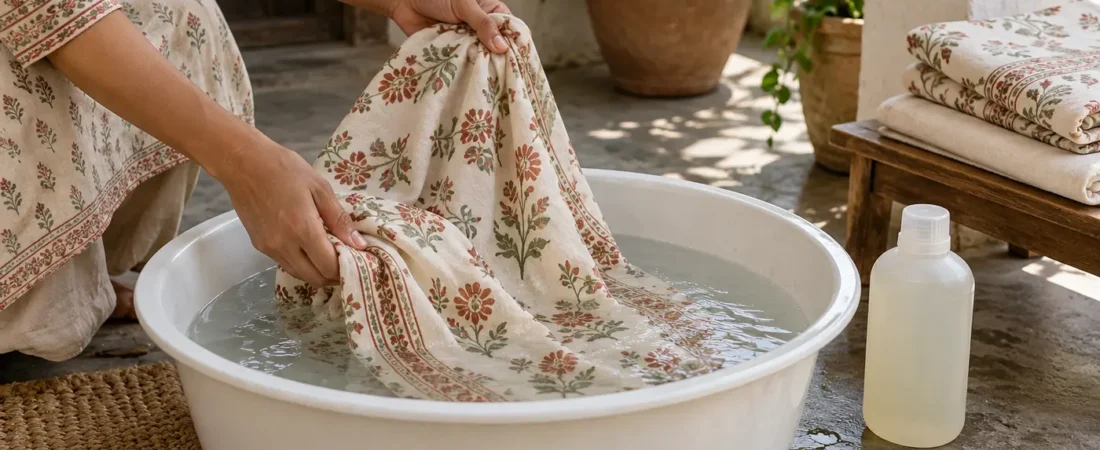
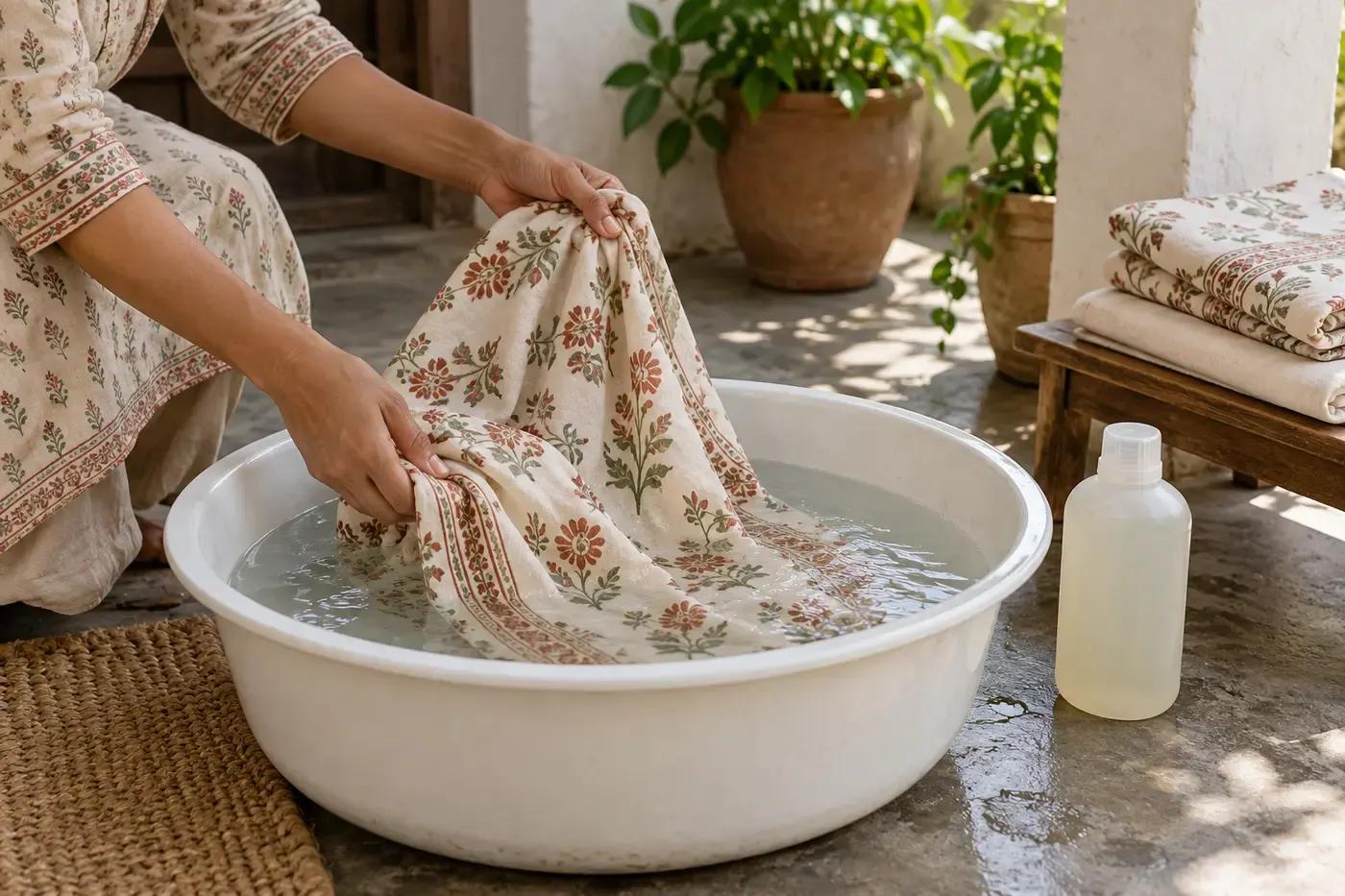
Where hand washing is allowed, use a clean basin large enough for the textile and follow the specified temperature. Move the fabric gently rather than scrubbing a motif or twisting the entire piece. Rinse according to the care instructions until detergent is removed; do not leave the textile sitting in dirty wash water.
Lift wet fabric with support. Large pieces become cumbersome, and carrying them by one corner puts stress on that small area. If the label permits removing water by rolling in a clean towel, use that approach carefully. Avoid inventing a forceful wringing method for a piece whose construction you do not understand.
What to do if colour starts bleeding
Stop the process and separate the affected item from other textiles. Do not add hot water, bleach, salt or vinegar in a panic. Record which product was used, the water temperature and what you observed, then contact the seller for item-specific guidance. A clear photograph is more useful than several successive treatments that obscure what happened.
Do not dry or iron a colour-transfer problem before you have sought appropriate advice. The next step depends on the dye, fabric and affected pieces. A general blog cannot safely prescribe one rescue method for every printed sheet. Prevention through sorting and correct care is more manageable than an improvised attempt to reverse a mixed-load accident.
Shade drying and protecting the print
Follow the drying label, including whether line drying, flat drying or tumble drying is allowed. For printed textiles instructed to dry in shade, choose a ventilated place with indirect light. Spread the fabric so air can circulate and avoid prolonged exposure after it is dry merely to keep the laundry area tidy.
Use a clean line or rack and distribute the load. Do not fold a damp coloured border tightly against a pale part for hours. Turn or reposition a large piece if that helps it dry evenly without stretching. A well-planned drying arrangement protects everyday usability as much as a carefully selected wash programme.
Carded-cotton quilts and Jaipuri razais need separate care
A cotton-filled quilt can have an outer fabric that tolerates water while its filling or stitching requires another approach. Confirm whether the whole item is washable, whether professional cleaning is recommended, and how it should be dried. Do not infer washability from the word cotton or from a light overall weight.
For a piece that the maker allows to be washed, consider the wet bulk and how the filling is secured. Support it during handling and dry it in the manner specified, checking that the centre and seams are completely dry before storage. If the filling shifts or the stitching fails, ask for guidance before trying to pull it back through the fabric.
Spot care without spreading the problem
Respond to a fresh spill by removing loose material gently and blotting, where appropriate, with a clean absorbent cloth. Avoid grinding a coloured spill into the weave. Read the care label and pretest any permitted treatment away from a visible motif. The University of Georgia’s stain guidance emphasises label checks and testing.
Describe the spill accurately if you seek help: what it was, when it happened and what has already been applied. A tea spill, oil mark and transferred dye are different problems. Do not cover the whole area with an aggressive cleaner simply because a short video recommended it for another fabric.
Ironing, folding and storage
Use only the ironing temperature and method the label permits. If advised, work from the reverse or with an appropriate pressing cloth. Do not assume that every cotton print tolerates the hottest iron setting, particularly when a finish, print binder or embellishment is present. Let the textile cool and dry fully before putting it away.
Store clean bedding in a dry place with room to access it easily. Avoid compressing a piece while any dampness remains in its centre or folded hems. Check seasonal bedding periodically rather than discovering a musty smell on the first cold night. Do not rely on perfume to conceal a moisture problem.
A quick decision before every wash
| What you notice | Useful next step |
|---|---|
| Care label is missing | Ask the seller before washing |
| New damage or wrong item | Document and contact the seller before use |
| Filled layer with unclear instructions | Confirm care for the whole item, not just its shell |
| Obvious colour transfer | Pause and request product-specific guidance |
| Insufficient drying space today | Choose a more practical washing time |
This pause is especially useful when more than one person handles the laundry. Keep separate instructions for a washable bedsheet and a filled quilt even if they share a similar print. Products that look coordinated do not necessarily have the same construction or maintenance needs.
When you buy a second set, keep its own label rather than assuming it matches the first. A different range, production batch or filling can change the instructions. Clear records reduce guesswork, and they help the seller understand your question if a problem appears later. The goal is a reliable household routine, not an expanding collection of treatments you hope will work.
Make a routine you can keep
Separate everyday sheets from filled seasonal layers in your care plan. Keep the product instructions where the person doing the laundry can find them, including a household helper or family member. A quick note such as “wash separately, label temperature, shade dry” is more useful than expecting someone to remember a long purchase conversation.
Use the Shaiyaa Care Guide for the visual overview and the general cotton bedding care article for a broader routine. For a specific design or filling, ask Shaiyaa before experimenting.
Frequently asked questions
Does salt stop a printed bedsheet from bleeding?
Do not assume so. Salt used in a particular dyeing process is not a universal fix for an already manufactured textile. Follow product-specific care instructions.
Can I use vinegar to set hand-block print colours?
Not as a blanket rule. Vinegar can affect some dyes. Use a special treatment only when the maker confirms it for the item concerned.
Should the first wash always use cold water?
Use the temperature stated on the care label. Cool water may be specified for many printed items, but a general article should not replace the product’s instructions.
Can a colourfastness test guarantee a safe wash?
No. It may reveal a concern but cannot guarantee every colour or the result of full laundering. Stop and ask for guidance if colour moves.
Can all cotton-filled quilts be machine washed?
No. Filling, stitching, wet weight and care instructions matter. Confirm washability before immersing a cotton-filled quilt or razai.
How do I prevent damp storage smells?
Dry the whole textile completely, including seams and inner layers where relevant, before storing it clean in a dry place. Investigate moisture rather than masking it with fragrance.